Share

Cassava Pellets – Small Grains, Big Impact --> - Thai Cassava Pellets, Global Potential
Last updated: 12 Jan 2026
152 Views

 Thai Cassava Pellets: A Strategic Agricultural Innovation for Global Markets

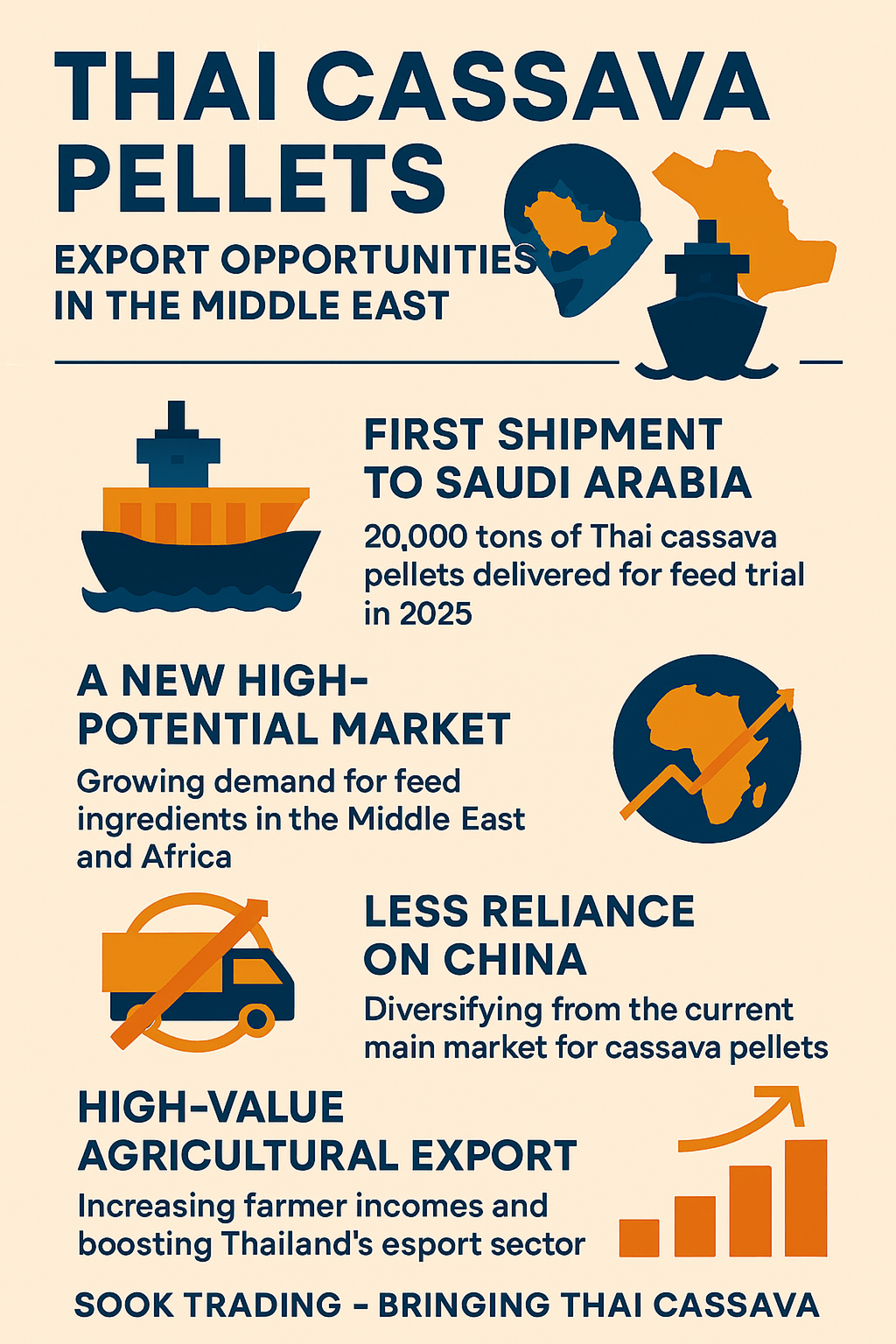
Thai cassava pellets are emerging as a high-potential agricultural export, with Thailand recently shipping its first historic batch of 20,000 tons to Saudi Arabia. This milestone marks the opening of new markets in the Middle East and Africa, offering Thai producers and exporters a chance to diversify beyond China and unlock greater value.

 Product Overview

Raw Material: Made from dried cassava chips derived from fresh cassava roots
Production: Primarily sourced and processed in Thailand, with supplementary supply from neighboring countries
Advantages:
Reduced transport loss (less dust and fragmentation)
Higher density for efficient shipping
Ideal for animal feed and bioenergy industries
 
Export Landscape

Saudi Arabia: First shipment of 20,000 tons arrived at Dammam Port in 2025–2026 for feed trials
Traditional Market: China remains a major buyer for feed and ethanol production
New Markets: Middle East and Africa are being actively developed to reduce risk and enhance value
 
Strategic Opportunities

Market Diversification: Expanding into Saudi Arabia and the Middle East reduces reliance on China
Farmer Value Creation: Rising cassava prices driven by new demand
Industrial Upscaling: Potential applications in food, beverages, adhesives, and paper industries
 

⚠️ Key Challenges

Regional Competition: Vietnam and Indonesia are active players in the global cassava market
Quality Standards: Maintaining GAP certification and traceability is essential
Value-Added Development: Investment in modified starch and bioenergy products is needed for long-term stability
 

Future Outlook

Despite challenges such as El Niño, mosaic disease, rising production costs, and raw material substitution in China, Thai cassava pellets remain well-positioned for growth. Government support, improved starch content, and disease-resistant varieties will be key to sustaining competitiveness.


SOOK TRADING – Your Trusted Export Partner

SOOK TRADING delivers Thai cassava pellets with international standards, traceability, and market-specific solutions.
We help clients expand into high-potential regions like the Middle East and Africa, offering reliable logistics, consistent quality, and strategic insight.
Partner with us to unlock the full potential of Thai agricultural innovation.

Related Content
Trend agricultural product from Thailand cassava starch , natural rubber
Thailand's cassava starch and natural rubber sectors are trending towards higher value, diversified use (like bioplastics, food ingredients), driven by global demand for sustainable materials, food security, and links to booming markets like China, though challenges include land scarcity and disease for rubber, with innovation focused on agroforestry and bio-based products to maintain leadership. Cassava Starch Trends Value-Added Products: Shift from raw chips to native starch, modified starch, and cassava flour (for gluten-free foods, pharmaceuticals). Bioplastics & Biofuels: Growing use in bioplastics and biofuels, supported by government R&D, positioning Thailand as a potential bioplastic hub. Key Markets: Strong demand from China for animal feed, alcohol, and food; growing food & beverage sector globally. Market Position: Thailand dominates global exports, especially native starch, despite some market fluctuations. Natural Rubber Trends Global Dominance: Remains the world's largest supplier, a key commodity. Diversification: Focus on intermediate rubber goods (gloves, tires) and exploring agroforestry systems for resilience and multiple products. Challenges: Land constraints, climate change impacts, disease, and labor costs affect supply, leading to a shrinking cultivation area. Innovation: Agroforestry (mixed crops with rubber) enhances farm diversity and sustainability, countering challenges. Overarching Themes Sustainability: Bio-based economy (BCG model) drives innovation in cassava and rubber to create high-value, green products. Market Reliance: Heavy dependence on China for cassava, requiring market diversification. Resilience: Need for innovation (like agroforestry for rubber) to overcome environmental and supply chain pressures.
4 Jan 2026
มันอัดเม็ด สินค้าดาวรุ่งจากไทย บุกไกลยังตลาด ตะวันออกกลาง และอาฟริกา และเกร็ดความรู้มันเส้น
มันอัดเม็ดหรือที่เรียกว่า มันเม็ดผลิตโดยการอัดมันเส้นโดยเครื่องอัดภายใต้สภาวะความร้อนและความดัน หลังจากอัดแล้วจะมีลักษณะเป็นท่อนยาว ประมาณ 2-3 ซม. เส้นผ่าศูนย์ กลางประมาณ 1 ซม. ความชื้นประมาณร้อยละ 14 ซึ่งจะส่งออกไปต่างประเทศเพื่อใช้เป็นวัตถุดิบสำหรับอาหารสัตว์ เนื่องจาก มันเม็ดจะมีีปริมาณแป้งสูง (มากกว่า ร้อยละ 65) จึงใช้้เป็นแหล่งอาหารให้พลังงานของสัตว์ เนื่องจากมันเม็ดมีส่งได้ตลอดปีและราคาไม่สูงขึ้นเมื่อเทียบกับผลิตผลของธัญพืชต่าง ๆ ดังนั้น หลายประเทศจึงนิยมใช้มันเม็ดของไทยในอุตสาหกรรม อาหารสัตว์ มันเม็ดมีปริมาณการส่งออก ประมาณ 5 ล้านตันต่อปี ข้อได้เปรียบที่สำคัญของมันเม็ด คือ สามารถขนส่งได้ง่าย (ไม่มีฝุ่นเหมือนมันเส้น) ขนย้ายได้สะดวกสามารถใช้เครื่องจักร ในการขนส่งได้เช่นเดียวกับเมล็ดธัญพืชต่าง ๆ
16 Dec 2025
This website uses cookies for best user experience, to find out more you can go to our Privacy Policy and Cookies Policy
Compare product
0/4
Remove all
Compare
Powered By MakeWebEasy Logo MakeWebEasy