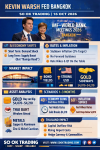
“Global Signals from Bangkok: Kevin Warsh Shakes the Economy — Fed’s Hawkish Stance, AI, Inflation, and Gold from the IMF–World Bank 2026 Stage” SO OK TRADING Insight | October 16, 2026
“In-Depth Analysis: Kevin Warsh’s Fed Speech in Bangkok — SO OK TRADING | October 16, 2026”
IMF–World Bank Annual Meetings 2026
On October 16, 2026, the IMF–World Bank Annual Meetings 2026 held at the Queen Sirikit National Convention Center in Bangkok became the center of global investor attention. Kevin Warsh, Chairman of the U.S. Federal Reserve (Fed), shared the stage with IMF Managing Director Kristalina Georgieva, delivering critical signals on the future of global economics and U.S. monetary policy.
AI, Inflation, and Data-Driven Policy
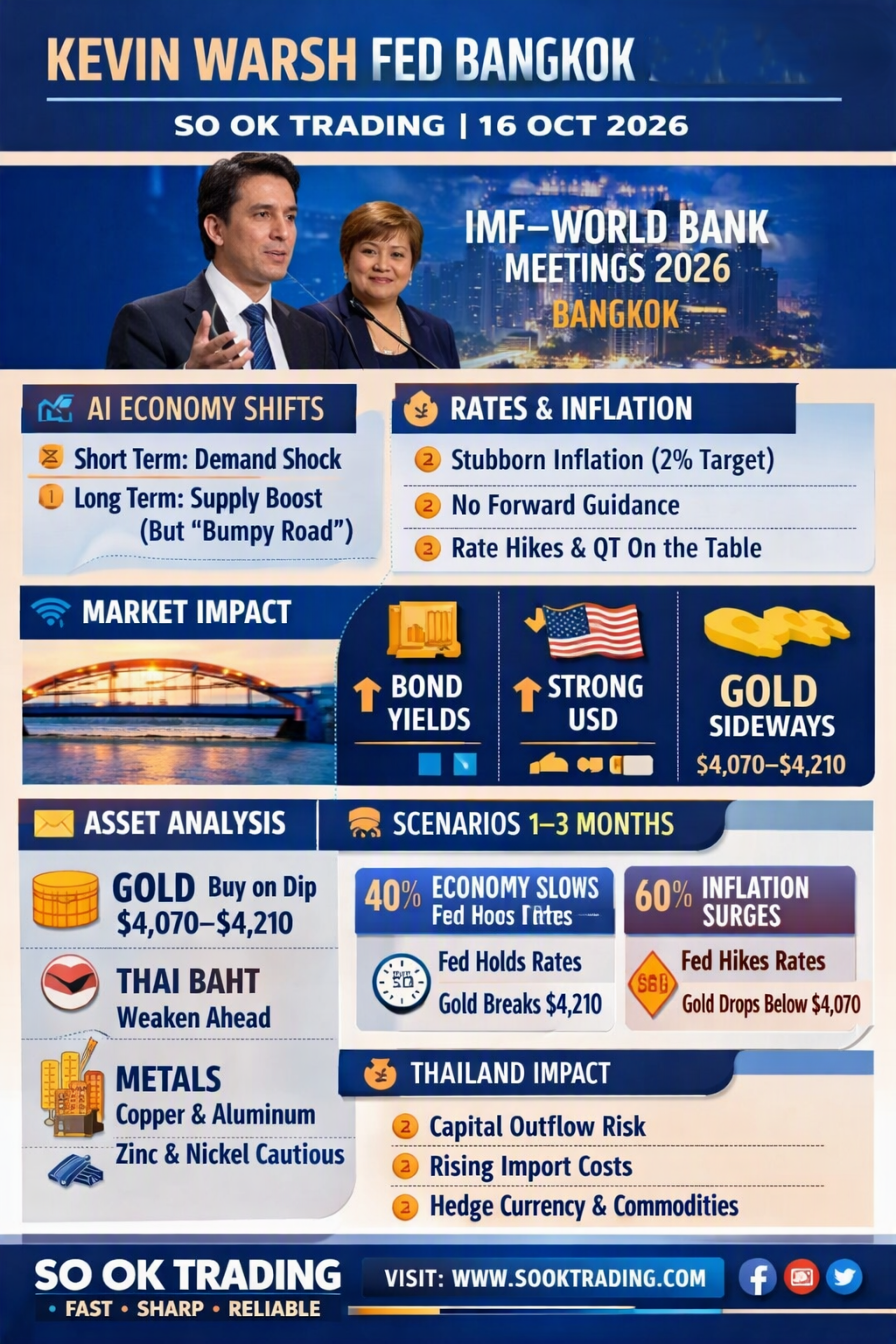
Warsh emphasized that AI represents the greatest productivity revolution of his lifetime, reshaping both U.S. and global economic structures.
Short Term: AI is disrupting demand-side dynamics.
Medium to Long Term: AI will boost supply-side efficiency, reduce costs, and ease inflationary pressures, though the transition will be “uneven and bumpy.”
He also highlighted the persistent challenge of inflation, reaffirming the Fed’s clear target of 2%. Warsh stressed that the Fed will eliminate Forward Guidance, choosing to “speak less” to preserve flexibility. Rate hikes remain on the table, but not as the sole instrument — Quantitative Tightening (QT) may be intensified to drain liquidity.
Market Impact
Hawkish tone forced markets into repricing.
Bond yields remain elevated, supporting a stronger U.S. dollar and pressuring the Thai baht.
Gold trades sideways between $4,070–$4,210, balancing dollar strength against inflation and geopolitical concerns.
Asset Analysis
Gold: Tested $4,170–$4,175. Strategy: “Buy on Dip” at $4,070 (≈ THB 65,000) and take profit near $4,210 (≈ THB 66,400).
Thai Baht: Short-term strength from dollar pause, but medium-term weakness due to interest rate differentials.
Non-Ferrous Metals:
Copper & Aluminum: Supported by AI infrastructure and data center demand.
Zinc & Nickel: Vulnerable to high financing costs, likely to consolidate.
Market Scenarios (1–3 Months)
Scenario 1 (40%): U.S. economy slows → Fed holds rates → Gold breaks $4,210, baht strengthens below 34.00.
Scenario 2 (60%): Inflation accelerates → Fed hikes → Gold drops below $4,070, baht weakens beyond 35.50.
Impact on Thailand’s Economy
Bank of Thailand constrained: Cutting rates risks capital outflows.
Rising import costs: Baht depreciation raises energy and raw material expenses.
Business advice: Hedge both FX and commodity exposure, reduce floating-rate debt to stabilize cash flow.
Investment Strategy & Portfolio Allocation
Cash / High Liquidity Assets (15–20%): Stay ready during volatility.
Gold (10–15%): Inflation hedge, buy on dips.
Tech/AI Stocks: Select companies with strong cash flows and real productivity gains from AI.
Conclusion
Warsh’s remarks signal a “Quietly Hawkish” Fed, reducing forward guidance while deploying all tools to bring inflation back to 2%. The result: heightened global market volatility. Thai investors and businesses must brace for sharp currency swings, uncertain gold prices, and rising costs in non-ferrous metals and energy.
✨ FAST • SHARP • RELIABLE SO OK TRADING — Your trusted business partner in the new economic world WWW.SOOKTRADING.COM Facebook: SO OK TRADING