“Global Currency Showdown: Dollar Sets the Fate – Thai Baht Strikes Back!” (7–11 September 2026 | SO OK TRADING)
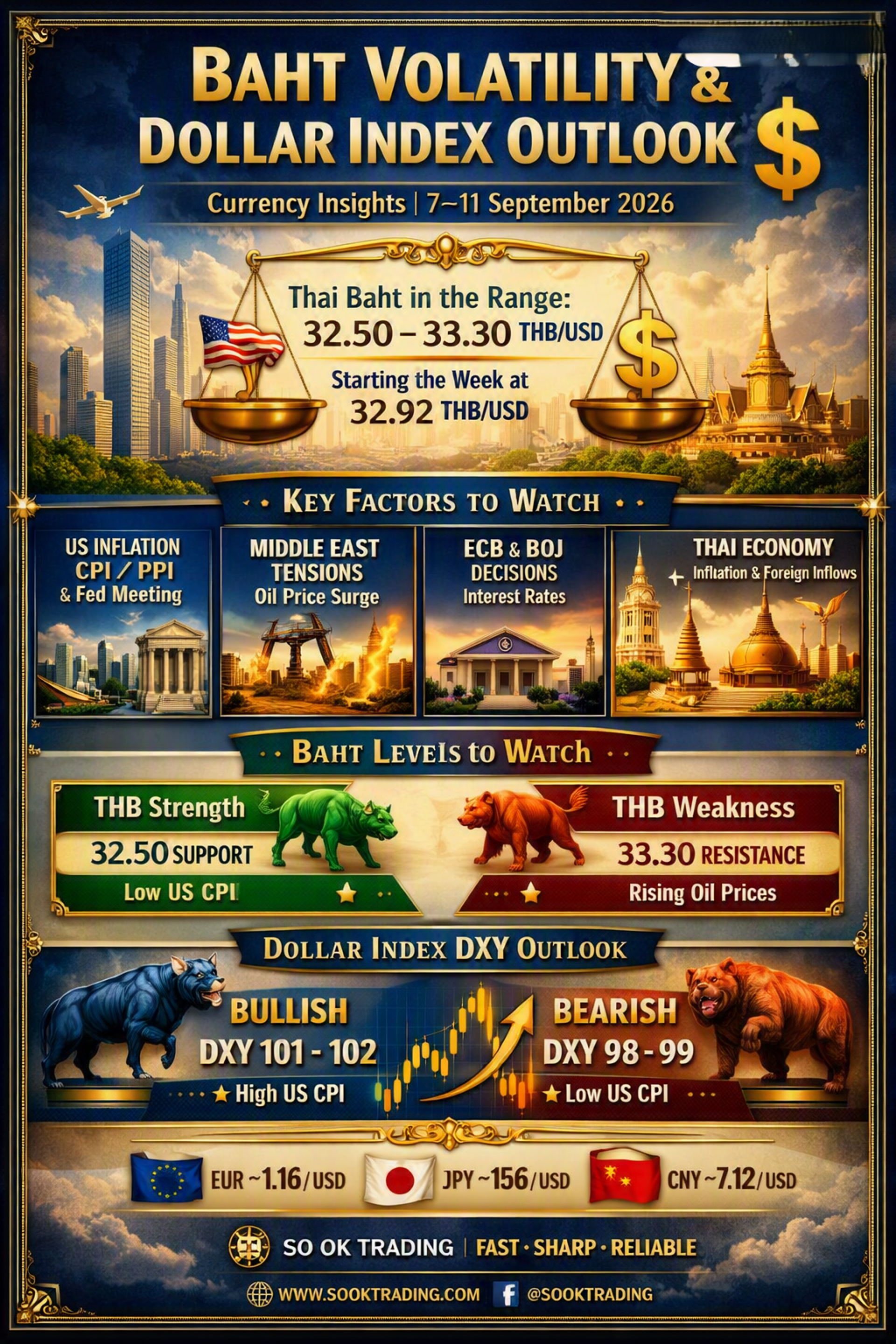
“Baht Volatility – Dollar Shapes the Global Outlook” (Outlook: 7–11 September 2026 | SO OK TRADING | FAST • SHARP • RELIABLE)
Thai Baht Overview
This week, the Thai Baht continues to trade within the 32.50–33.30 THB/USD range, opening at 32.92 THB/USD. Despite efforts to stay below 33.00, the currency faces pressure from U.S. economic data. The situation is defined as a Two-Way Risk — with potential for both appreciation and depreciation.
Key Drivers
U.S. Inflation (CPI/PPI): August figures will be crucial for the Fed’s meeting on September 15–16. Lower-than-expected inflation could weaken the dollar and strengthen the Baht.
Middle East Tensions: Rising oil prices may weigh on the Baht due to higher import costs.
ECB & BOJ Decisions: Markets are watching for possible ECB rate hikes and BOJ adjustments.
Domestic Factors: Thai inflation for August is expected at 2.4%, with foreign fund flows remaining influential.
Support & Resistance Levels
Support: 32.50–32.80 THB/USD
Resistance: 33.00–33.30 THB/USD
If U.S. CPI is lower than expected → Baht could strengthen past 32.75 and test 32.50 If oil prices surge → Baht may weaken beyond 33.00, heading toward 33.20–33.30
Dollar Index (DXY) Outlook
The Dollar Index is moving within 99.10–99.50, with analysts projecting a September range of 98.00–102.00, reflecting investor confidence in U.S. economic policy.
Bullish Scenario: Higher CPI → DXY breaks 100, heading to 101–101.50 → Baht weakens to 33.30
Bearish Scenario: Lower CPI → DXY falls to 98.50–98.68 → Baht strengthens to 32.50
Forecasts from Leading Institutions
Krungthai GLOBAL MARKETS: Range 32.50–33.30; Baht shows trend-following strength but risks weakness if oil prices surge.
KBank / KResearch: Support at 32.50, resistance at 33.20; focus on Thai CPI (+2.4%) and foreign fund flows.
Krungsri Global Markets: Range 32.75–33.30; awaiting ECB decisions and U.S. inflation data.
SCB FM: Narrow daily range 32.75–33.00; Baht stable with oil prices despite strong U.S. NFP.
ttb: Daily range 32.80–33.10; short-term test of 33.10 possible during U.S. Labor Day.
Global Currency Snapshot
Euro (EUR): Stronger against USD (~1.16), stable against THB (~38.26).
Japanese Yen (JPY): Stronger against USD (~156/USD), but weaker against THB (~4.15–4.23/100 JPY).
Chinese Yuan (CNY): Stable against USD (~7.10–7.15/USD), stable against THB (~4.55–4.65/CNY).
✨ Strategic Summary
This week’s Baht movement is a tug-of-war between dollar weakness and oil price pressure.
Lower U.S. CPI → Baht could strengthen to 32.50
Escalating Middle East tensions and rising oil → Baht could weaken to 33.30
Exporters & Importers: Should hedge to mitigate volatility risks
Investors: Strong Baht and Yen favor tourism and imports
Thai Stock Market: SET Index surpasses 1,600, driven by tech stocks and savings stimulus
SO OK TRADING: Your Trusted Business Partner FAST • SHARP • RELIABLE www.sooktrading.com Facebook: SO OK TRADING