“RDF‑3 Clean Energy from Waste and Old Shoes: Smart Energy Driving the World Toward a Net Zero Future” SO OK TRADING INSIGHT · 3 SEP 2026
RDF‑3 from Waste, Residual Materials, and Old Shoes
Clean Energy for a Sustainable Future
As the world faces energy crises and overflowing waste problems, “old shoes” once considered worthless are now being transformed into RDF‑3 (Fluff RDF) — a clean, high‑calorific alternative fuel that reduces dependence on coal and accelerates the transition toward a circular economy and global Net Zero goals.
What is RDF‑3?
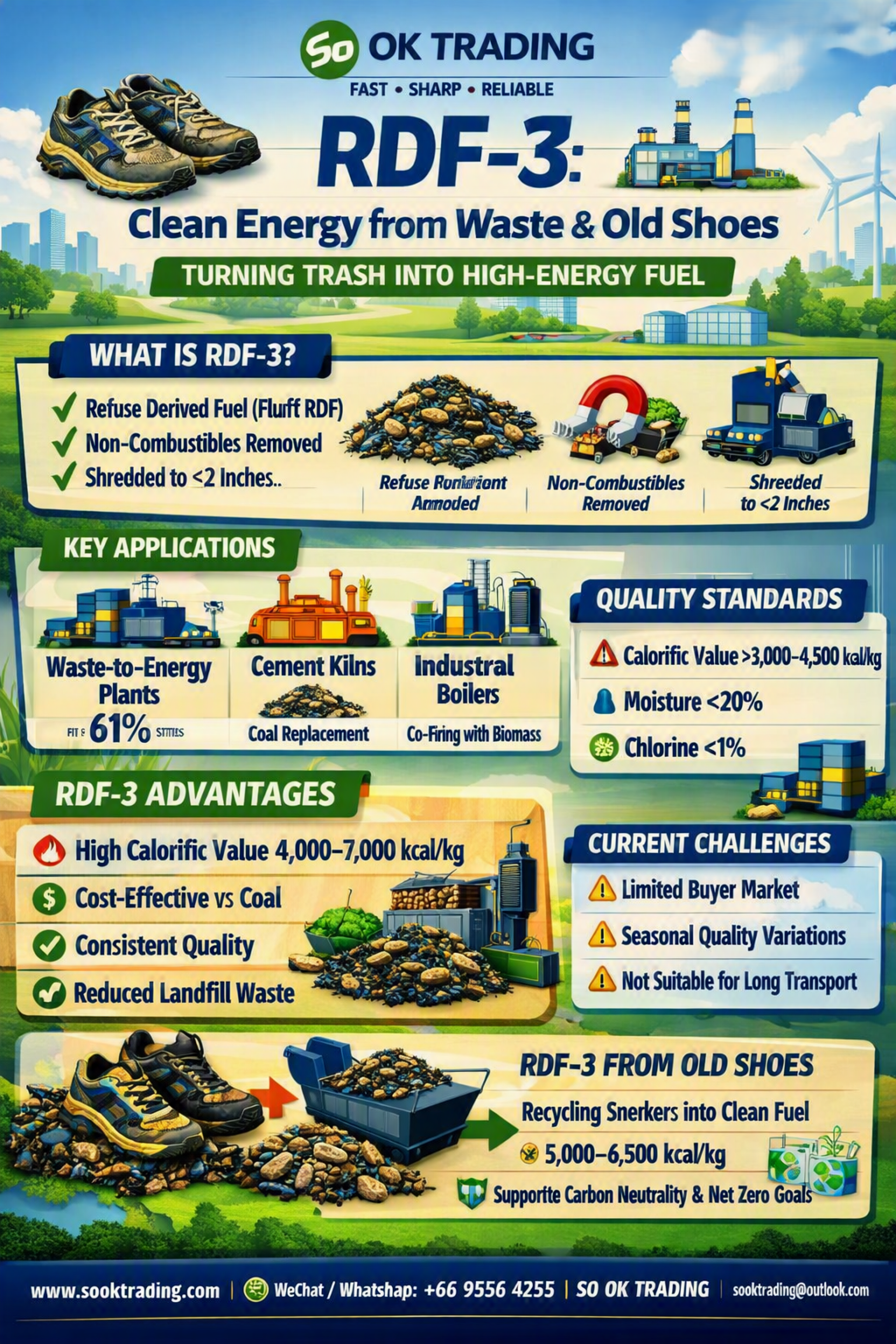
Refuse‑derived fuel produced by removing non‑combustible materials such as glass and metals
Shredded into pieces smaller than 2 inches (95% ASTM standard)
High calorific value and uniform size, ideal for industrial kilns and waste‑to‑energy plants
Key Applications
Waste‑to‑Energy Plants: Largest consumer (over 61%), supported by FiT subsidies, requiring advanced pollution control
Cement Kilns: Replaces coal at >1,400°C, with ash incorporated into cement, supporting Net Zero targets
Industrial Boilers & Kilns: Often co‑fired with biomass to reduce emissions
Advantages of RDF‑3
High calorific value: 4,000–7,000 kcal/kg
Cost‑effective compared to imported coal
Uniform size, easy to transport and feed into combustion systems
Challenges
Limited buyer market (mainly cement and large WtE plants)
Seasonal quality variations (moisture, contaminants)
Lightweight and fluffy, making long‑distance transport uneconomical
Quality Standards
Calorific Value (LHV):
WtE plants: >3,000–3,500 kcal/kg
Cement kilns: >4,000–4,500 kcal/kg
Moisture:
WtE plants: <20–25%
Cement kilns: <15%
Ash Content:
WtE plants: <15–20%
Cement kilns: <10–12%
Contaminants:
Chlorine <0.5–1.0%
Sulfur <0.5%
Heavy metals within environmental standards
Physical Specs:
Particle size <50 mm (95%)
Bulk density 150–250 kg/m³
Comparison with Other RDF Types
RDF‑2 (Coarse): Easy to produce but high contamination → RDF‑3 offers superior quality
RDF‑5 (Densified): Easier to transport and store but more expensive → RDF‑3 is cheaper and suitable for local use
Global Outlook
Market projected to grow from USD 7.34 billion → USD 10.12 billion by 2031 (CAGR 5.56%)
Transition toward SRF (Solid Recovered Fuel) under EN 15359 standards
Adoption of AI and optical sorting to reduce chlorine and improve quality by 21%
Cross‑border trade expanding, with the UK and Northern Europe as major exporters
Thailand Outlook
Market booming with 15.1% growth, reaching THB 14.5 billion
Power sector (64%): New community WtE plants entering COD, supported by FiT
Industrial sector (36%): Cement and large factories reducing coal imports to avoid carbon tariffs
Future trend: Cement plants establishing RDF‑3 production near landfills to cut transport costs and feed directly into Precalciner systems
RDF‑3 from Old Shoes
Old shoes composed of rubber, foam, and fabric
Provide calorific value of 5,000–6,500 kcal/kg with moisture <20%
Premium feedstock for RDF‑3, ensuring complete combustion and environmental safety
Supports Thailand’s Carbon Neutrality 2050 and Net Zero 2065 targets
Production & Sales Strategy
Separate soft plastics → high calorific value, low chlorine
Avoid PVC → use Near‑Infrared scanning to reduce chlorine levels
Apply Bio‑drying → reduce moisture from 50–60% to <15–20%, boosting calorific value without fossil fuels
Conclusion
RDF‑3 (Fluff RDF) is more than just refuse‑derived fuel — it is the energy of the future, reducing coal dependence, driving the circular economy, and supporting Net Zero goals globally. From discarded shoes once destined for landfills, RDF‑3 emerges as a clean, high‑value fuel, exemplifying how waste can be transformed into energy and economic opportunity.
SO OK TRADING — FAST • SHARP • RELIABLE Your trusted partner in clean energy solutions
Contact Us
Website: www.sooktrading.com
Facebook: SO OK TRADING
WeChat / WhatsApp: +66 95564255
Email: sooktrading@outlook.com