“Thailand Steel Industry 2026–2027: A New Era of Thai Steel Towards a Sustainable Green Future — The Turning Point, with SO OK TRADING Leading the Way”
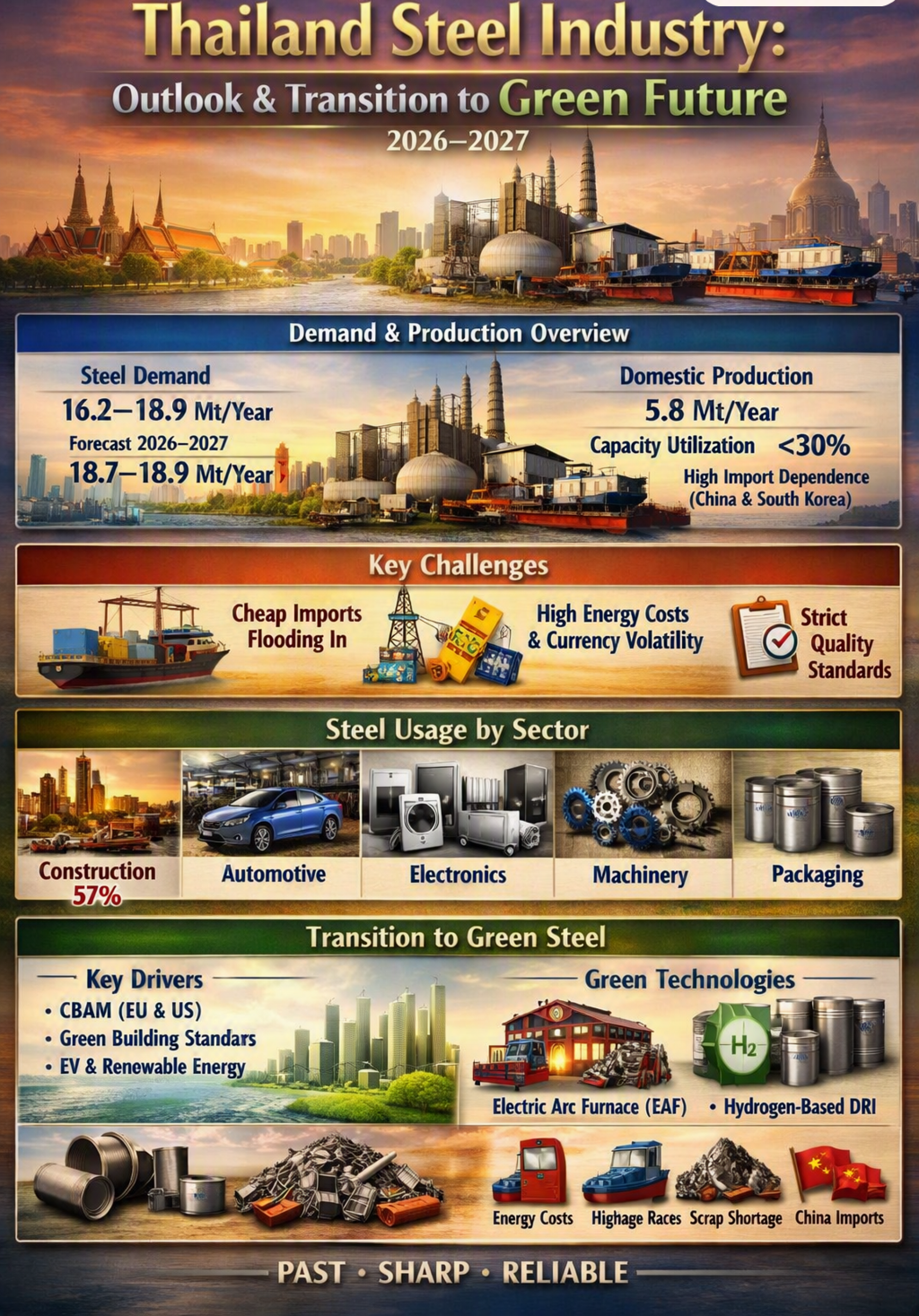
Thailand Steel Industry: Overview, Current Situation, and Future Transition (2026–2027) : SO OK TRADING : 2 August 2026
Demand and Production Overview
Thailand’s steel demand averages 16.2–18.9 million tons per year. For 2026–2027, demand is expected to rise slightly to 18.7–18.9 million tons, in line with economic recovery and government investment projects.
Domestic Production Capacity: around 5.8 million tons, with utilization below 30%
Imports: heavily reliant on steel from China and South Korea due to lower prices and steady supply
⚠️ Challenges
Competition from cheap imported steel undermines local producers
Rising energy costs and currency volatility pressure factory prices
Strict quality standards enforced by the Thai Industrial Standards Institute (TISI) to block substandard steel
Steel Usage by Major Industries
Construction – Long steel products dominate (57% of total consumption), especially for government mega projects
Automotive & Parts – High-quality steel sheets for car bodies and components
Electronics & Appliances – Coated steel for refrigerators, washing machines, and air conditioners
Machinery & Equipment – Agricultural and industrial machinery
Packaging – Tin- and chromium-coated steel for food and beverage cans
Transition to “Green Steel”
Thailand’s steel industry is entering a critical transition, with low-carbon steel becoming a key condition for global competitiveness.
Drivers:
EU/US CBAM (Carbon Border Adjustment Mechanism)
TREES green building standards
Demand from EV and renewable energy industries
Key Technologies:
Electric Arc Furnace (EAF) – Recycling scrap steel with low carbon emissions
Hydrogen-based DRI/HBI – Using green hydrogen to cut carbon emissions by 70–90%
Scrap Steel: Essential Raw Material
Thailand lacks upstream iron ore smelting, relying mainly on scrap recycling.
Annual Usage: 5.2–6 million tons
Sources:
Domestic Scrap ~4 million tons (Prompt + Obsolete Scrap)
Imported Scrap ~1.2–2 million tons
Challenges: insufficient supply, high contamination, stricter environmental regulations
Construction Steel Trends
Government Sector: Infrastructure projects such as railways and expressways drive demand
Private Sector: Real estate and housing remain sluggish
Steel Types:
SD50 deformed bars popular in high-rise projects
RB round bars declining, used only in small structures
Standard lengths of 10–12 meters dominate the market
Global and Thai Market Outlook
Global Market:
Demand recovery (2026 +0.3–0.4%, 2027 +2.2%)
India and ASEAN are growth bright spots
Risk: excess capacity may reach 745 million tons by 2028
Thai Market:
Facing “4-Crisis Shock”: high energy costs, volatile shipping rates, scrap shortages, and Chinese dumping
Limited consumption recovery, but structural reform is essential for survival
✨ Conclusion
Thailand’s steel industry faces strong pressure from import competition and rising energy costs. Yet, the transition to Green Steel offers a crucial opportunity. Investment in low-carbon technologies and structural reform is not optional — it is the condition for survival.
SO OK TRADING: Your Trusted Business Partner FAST • SHARP • RELIABLE
Visit us at: WWW.SOOKTRADING.COM Facebook: SO OK TRADING