“Thai Cassava Industry 2026: Transforming, Adapting, Creating Value, Towards a Sustainable Future” SO OK TRADING | 27 July 2026
Thai Cassava and Cassava Chips Industry: A Turning Point for Adaptation
Article by SO OK TRADING | 27 July 2026
Current Situation
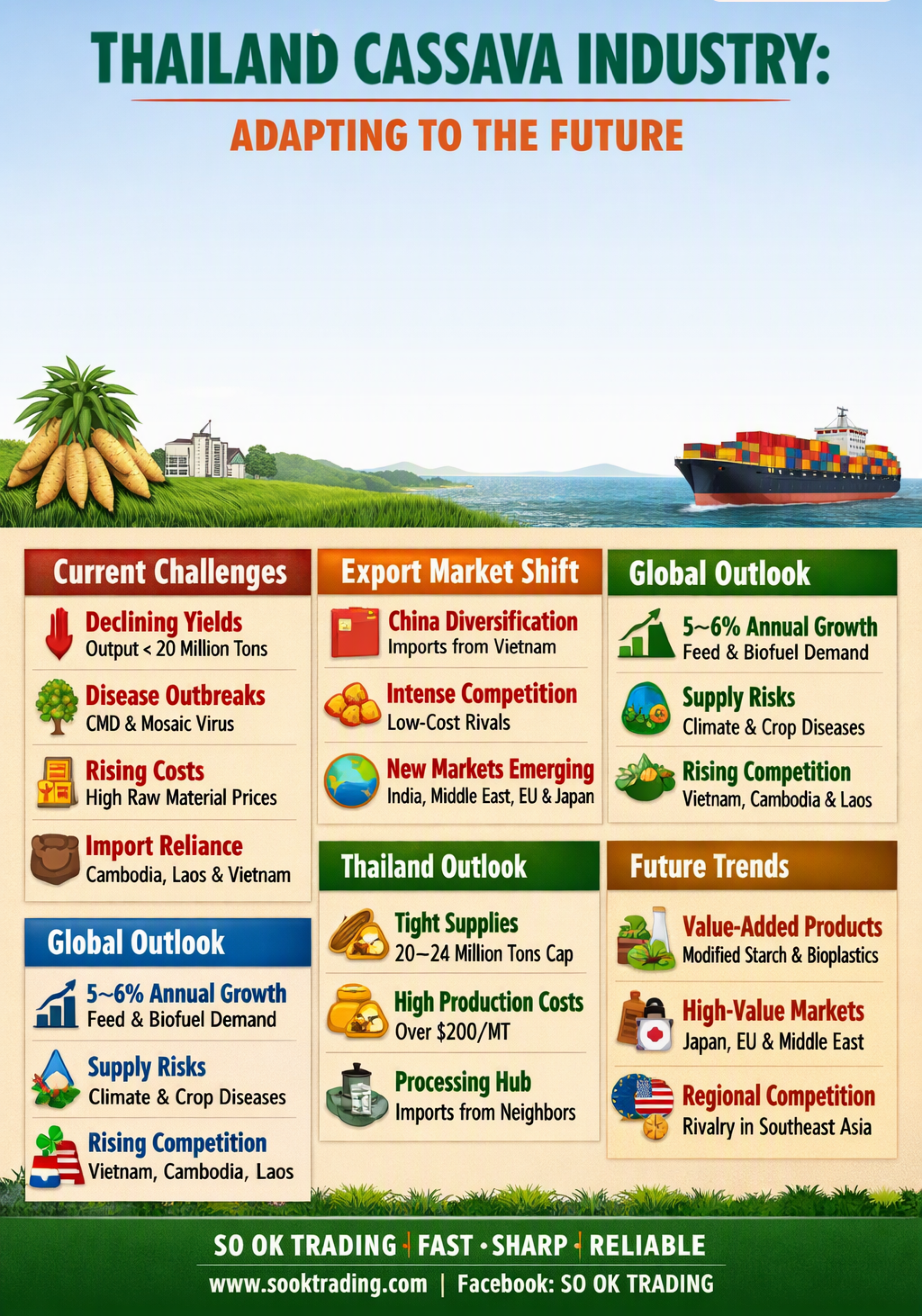
Thailand’s cassava and cassava chips industry is facing serious challenges from declining yields due to drought and crop diseases. Meanwhile, the main export market, China, has begun to change its import behavior, forcing Thailand to adapt quickly in order to maintain its leadership in the global market.
Declining Yields: Forecast for 2028/29 shows cassava root production may fall below 20 million tons.
Severe Crop Diseases: Cassava Mosaic Disease (CMD) and dwarfing disease continue to reduce yields per hectare.
Rising Costs: Factories compete for raw cassava, pushing prices to remain high (cassava chips average 7.40–7.60 THB/kg).
Dependence on Neighboring Countries: Border factories increasingly rely on imports from Cambodia, Laos, and Vietnam to supplement supply.
Market and Export
China No Longer the Sole Market: Once accounting for over 90% of exports, China now imports more from Vietnam and substitutes cassava with corn for animal feed.
Intensifying Competition: Neighboring countries with lower costs are eroding Thailand’s market share.
Emerging Potential Markets: India, Saudi Arabia, Japan, South Korea, the EU, the Philippines, and Indonesia.
Adaptation Strategies and Opportunities
Shift to Value-Added Products: Promote production of modified starch, bioplastics, and bio-economy products.
Clean/Premium Cassava Chips: Target quality-focused markets such as Japan and the EU.
Market Diversification: Reduce reliance on China and expand into new markets with strong demand for bioenergy and animal feed.
Global Outlook
Continued Demand Growth: Global cassava chip market expected to grow 5–6% annually until 2035.
Key Drivers: Animal feed industry, renewable energy (ethanol), and food security.
Supply Risks: Climate volatility and global spread of crop diseases.
Competitive Landscape: Thailand remains a leader, but Vietnam, Cambodia, and Laos are rising as strong competitors.
Thailand Outlook
Tight Supply in the Long Term: Production expected to remain capped at 20–24 million tons per year.
High Production Costs: Domestic cassava chip prices remain above 7 THB/kg.
Transition to Processing Hub: Thai factories increasingly rely on imported raw materials from neighboring countries.
End of China Dependence: Thailand must diversify markets and upgrade product quality.
Future Trends
Growth Limited by Supply: Natural disasters and crop diseases will continue to constrain production.
Shift to High-Value Products: Modified starch, bioplastics, and bio-economy products will become growth drivers.
Intensified Regional Competition: Vietnam, Cambodia, and Laos will be key rivals in raw cassava chip markets.
New Premium Market Opportunities: Japan, the EU, and the Middle East offer higher prices if Thailand can meet strict quality standards.
✦ Conclusion
Thailand’s cassava industry is entering a critical turning point. Moving away from dependence on China and low-value cassava chip production, the industry must embrace value-added processing and diversified markets to sustain leadership in the global market amid supply challenges and intensifying competition.
SO OK TRADING: Your Trusted Business Partner FAST • SHARP • RELIABLE www.sooktrading.com | Facebook: SO OK TRADING