Share

“Thai Cassava Industry 2026: Transforming, Adapting, Creating Value, Towards a Sustainable Future” SO OK TRADING | 27 July 2026
Last updated: 27 Jul 2026
2107 Views

Thai Cassava and Cassava Chips Industry: A Turning Point for Adaptation
Article by SO OK TRADING | 27 July 2026

 
Current Situation
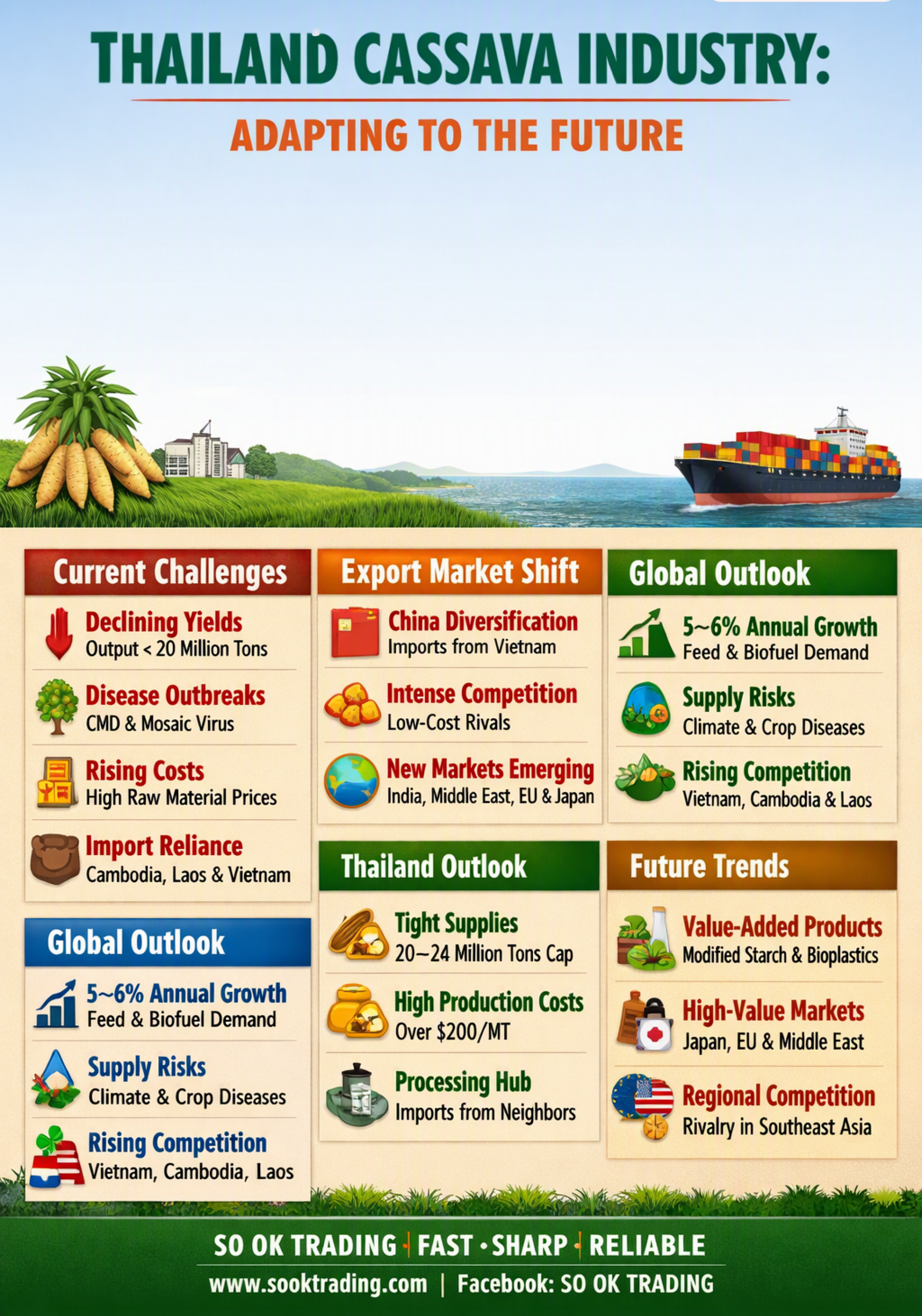
Thailand’s cassava and cassava chips industry is facing serious challenges from declining yields due to drought and crop diseases. Meanwhile, the main export market, China, has begun to change its import behavior, forcing Thailand to adapt quickly in order to maintain its leadership in the global market.

Declining Yields: Forecast for 2028/29 shows cassava root production may fall below 20 million tons.
Severe Crop Diseases: Cassava Mosaic Disease (CMD) and dwarfing disease continue to reduce yields per hectare.
Rising Costs: Factories compete for raw cassava, pushing prices to remain high (cassava chips average 7.40–7.60 THB/kg).
Dependence on Neighboring Countries: Border factories increasingly rely on imports from Cambodia, Laos, and Vietnam to supplement supply.
 
Market and Export
China No Longer the Sole Market: Once accounting for over 90% of exports, China now imports more from Vietnam and substitutes cassava with corn for animal feed.
Intensifying Competition: Neighboring countries with lower costs are eroding Thailand’s market share.
Emerging Potential Markets: India, Saudi Arabia, Japan, South Korea, the EU, the Philippines, and Indonesia.
 
Adaptation Strategies and Opportunities
Shift to Value-Added Products: Promote production of modified starch, bioplastics, and bio-economy products.
Clean/Premium Cassava Chips: Target quality-focused markets such as Japan and the EU.
Market Diversification: Reduce reliance on China and expand into new markets with strong demand for bioenergy and animal feed.
 
Global Outlook
Continued Demand Growth: Global cassava chip market expected to grow 5–6% annually until 2035.
Key Drivers: Animal feed industry, renewable energy (ethanol), and food security.
Supply Risks: Climate volatility and global spread of crop diseases.
Competitive Landscape: Thailand remains a leader, but Vietnam, Cambodia, and Laos are rising as strong competitors.
 
Thailand Outlook
Tight Supply in the Long Term: Production expected to remain capped at 20–24 million tons per year.
High Production Costs: Domestic cassava chip prices remain above 7 THB/kg.
Transition to Processing Hub: Thai factories increasingly rely on imported raw materials from neighboring countries.
End of China Dependence: Thailand must diversify markets and upgrade product quality.
 
Future Trends
Growth Limited by Supply: Natural disasters and crop diseases will continue to constrain production.
Shift to High-Value Products: Modified starch, bioplastics, and bio-economy products will become growth drivers.
Intensified Regional Competition: Vietnam, Cambodia, and Laos will be key rivals in raw cassava chip markets.
New Premium Market Opportunities: Japan, the EU, and the Middle East offer higher prices if Thailand can meet strict quality standards.
 
✦ Conclusion
Thailand’s cassava industry is entering a critical turning point. Moving away from dependence on China and low-value cassava chip production, the industry must embrace value-added processing and diversified markets to sustain leadership in the global market amid supply challenges and intensifying competition.

 
SO OK TRADING: Your Trusted Business Partner FAST • SHARP • RELIABLE www.sooktrading.com | Facebook: SO OK TRADING


Related Content
“Aluminum Coil 2026: Transforming the World with Innovation and Sustainability”   Subtitle: “Exploring Global Aluminum Producers’ Trends Towards Recycling and Advanced Packaging Technologies”
Aluminum Coil 2026: Transitioning into the Era of Sustainability and Innovation SO OK TRADING | October 4, 2026 In 2026, the aluminum coil industry is entering a pivotal era of transformation worldwide. With advancements in technology, recycling, and sustainability, global producers are accelerating development to meet the rising demand in electric vehicles (EVs), modern construction, and eco-friendly packaging. From Alcoa, Hindalco, Norsk Hydro, and Rusal to emerging players such as Aluminum Dynamics, EGA, Speira, and new entrants from China — every company is competing through AI-driven innovation, automation, and recycled scrap utilization, creating materials that are lightweight, durable, and low in carbon emissions. Thailand continues to serve as a vital hub in the ASEAN region, with Closed-Loop Recycling initiatives capable of turning used cans into new ones within just 60 days, saving up to 95% of energy compared to primary smelting. The aluminum packaging industry has become the cornerstone of this new growth era — from beverage cans to food packaging — utilizing specialized alloys such as 3004, 3104, 5182, and 5052, ensuring both strength and safety in application. As the world advances toward sustainability, SO OK TRADING remains a trusted business partner, delivering global-quality solutions and deep insights to clients across industries. SO OK TRADING — FAST • SHARP • RELIABLE
4 Oct 2026
Trend agricultural product from Thailand cassava starch , natural rubber
Thailand's cassava starch and natural rubber sectors are trending towards higher value, diversified use (like bioplastics, food ingredients), driven by global demand for sustainable materials, food security, and links to booming markets like China, though challenges include land scarcity and disease for rubber, with innovation focused on agroforestry and bio-based products to maintain leadership. Cassava Starch Trends Value-Added Products: Shift from raw chips to native starch, modified starch, and cassava flour (for gluten-free foods, pharmaceuticals). Bioplastics & Biofuels: Growing use in bioplastics and biofuels, supported by government R&D, positioning Thailand as a potential bioplastic hub. Key Markets: Strong demand from China for animal feed, alcohol, and food; growing food & beverage sector globally. Market Position: Thailand dominates global exports, especially native starch, despite some market fluctuations. Natural Rubber Trends Global Dominance: Remains the world's largest supplier, a key commodity. Diversification: Focus on intermediate rubber goods (gloves, tires) and exploring agroforestry systems for resilience and multiple products. Challenges: Land constraints, climate change impacts, disease, and labor costs affect supply, leading to a shrinking cultivation area. Innovation: Agroforestry (mixed crops with rubber) enhances farm diversity and sustainability, countering challenges. Overarching Themes Sustainability: Bio-based economy (BCG model) drives innovation in cassava and rubber to create high-value, green products. Market Reliance: Heavy dependence on China for cassava, requiring market diversification. Resilience: Need for innovation (like agroforestry for rubber) to overcome environmental and supply chain pressures.
4 Jan 2026
“Recycled Aluminum: Transforming the Global Economy Towards the Net Zero Era — From Cans to Clean Energy and Circular Economy Innovation” Article by SO OK TRADING | March 25, 2026
Recycled Aluminum is rapidly becoming a “strategic resource” driving the world toward Net Zero goals and a truly circular economy. From beverage cans to electric vehicle components, from food foil to building structures — recycled aluminum is no longer just part of the circular economy, but the very heart of future industries.
25 Mar 2026
This website uses cookies for best user experience, to find out more you can go to our Privacy Policy and Cookies Policy
Powered By MakeWebEasy Logo MakeWebEasy