“A New Decade 2026–2035: Thailand’s Aluminum Packaging Rising – Transforming into the Recycling Era and Driving a Sustainable Future” SO OK TRADING | July 1, 2026
Thailand Aluminum Packaging – From Pressure to a Decade of Sustainability
Outlook on the Transition of Thailand’s Aluminum Packaging Industry (2012–2026) and Future Trends (2026–2035) Article by SO OK TRADING | July 1, 2026
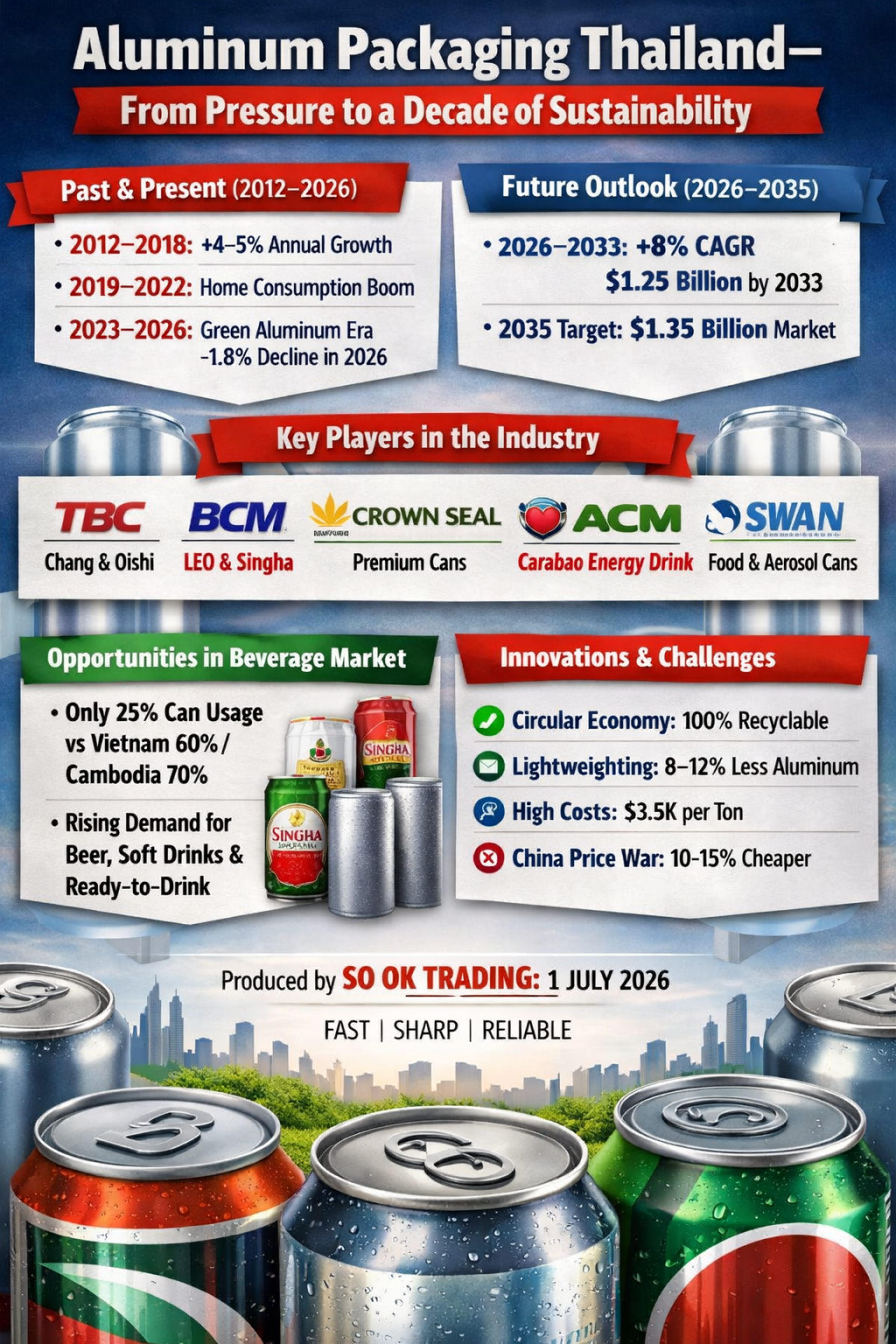
Thailand’s aluminum packaging industry is entering a critical transition. Although 2026 faces pressure from rising raw material costs and global tariff measures, resulting in a slight contraction of -1.8% YoY, the long-term outlook remains full of opportunities. The market is projected to reach USD 1.25 billion by 2033 and soar to USD 1.35 billion by 2035, driven by the momentum of the Circular Economy and Closed-loop Recycling.
Growth Trajectory and CAGR: Thailand’s Aluminum Packaging Industry
2012–2018: Average annual growth of 4–5%, fueled by beer and soft drinks. BJC held the largest market share at around 45%.
2019–2022: COVID-19 shifted consumption behavior toward home use, boosting demand for cans over glass bottles.
2023–2026: The Green Aluminum era with full-scale competition, CAGR 7–8%, but 2026 saw a -1.8% decline due to the USA–Iran war causing raw material shortages.
2026–2033 (Outlook): Expected CAGR of 8%, market size reaching USD 1.25 billion.
2035 (Target): Market size projected at USD 1.35 billion.
Market Value (2026): Mega-volume contracts worth THB 360–576 million per year, depending on can formats (Sleek, Slim, Standard, Tall). Consumption: Thailand uses 7–7.5 billion cans annually, with CAGR 3.58% between 2026–2031.
Beverage Can Market: A Rising Star
Key Drivers: Beer, soft drinks, ready-to-drink tea, coffee, and functional beverages.
Huge Potential: Thailand’s can usage is only 25% of the beverage market, compared to 60% in Vietnam and 70% in Cambodia.
Major Players Moving: BGC acquired 75% of BCM to expand into LEO and SINGHA packaging; TBC sales surged 37% YoY with premium drinks like CHANG and OISHI.
Food Can Market: Stable but Evolving
Limited Growth: Dependent on exports and processed foods such as tuna and pet food.
Material Competition: Tinplate steel dominates, but aluminum is gaining ground in Easy Open Ends (EOE) and BPANI (non-carcinogenic coatings).
Major Can Manufacturers in Thailand
Thai Beverage Can (TBC): Joint venture between BJC and Ball Corporation, capacity over 7 billion cans/year → CHANG beer.
Bangkok Can Manufacturing (BCM): BGC holds 75%, specializes in high-quality printing → SINGHA beer.
Crown Seal / Crown Ceramics: Subsidiary of Crown Holdings (USA), producing premium cans and ends.
D-Stone Can: Serving energy drinks and juice exports.
Swan Industries: Major producer of food and aerosol cans → EOEs, tab lids, 3-piece cans.
Royal Can Manufacturing: Focused on processed food cans such as tuna, pineapple, and pet food.
Next Can Innovation (NCI): Saraburi plant using Japanese sTULC technology → Birdy coffee cans, Red Bull.
ACM – Asia Can Manufacturing (Carabao Group): Produces Carabao Dang energy drink cans and Carabao beer cans.
⚡ ACM (Asia Can Manufacturing) Profile
Founded: 2018, joint venture between Carabao Group and Showa Aluminum Can (Japan).
Location: Bang Pakong, Chachoengsao, on 31 rai of land.
Capacity: Up to 1 billion cans per year.
Investment: Over THB 700 million (USD 21.3 million).
Main Client: Carabao Energy Drink, with expansion plans into China, the UK, and ASEAN.
Aluminum Packaging Advantages & Innovations
ESG & Circular Economy: 100% recyclable, with Thai producers targeting 74–80% recycled content by 2030.
Lightweighting: Reducing aluminum sheet thickness by 8–12% to cut costs and weight while maintaining strength.
⚡ Challenges Facing Thailand’s Industry
Rising Costs: Global aluminum prices at USD 3,150–3,530 per ton, raw materials account for 60% of production costs.
China Price War: Chinese products 10–15% cheaper than Thai equivalents.
Global Tariff Measures: US import tariffs raised to 50%, pushing Chinese exports into ASEAN.
Market Summary
Thailand’s aluminum packaging market is shifting from “price competition” to “quality and sustainability competition.” ACM of Carabao Group emerges as a new player strengthening supply stability and supporting Thai energy brands globally. The combination of Lightweighting + Circular Economy + Premiumization will be the key to winning the next decade.
✨ SO OK TRADING Your trusted partner in packaging and global trade FAST | SHARP | RELIABLE www.sooktrading.com Facebook: SO OK TRADING