Share

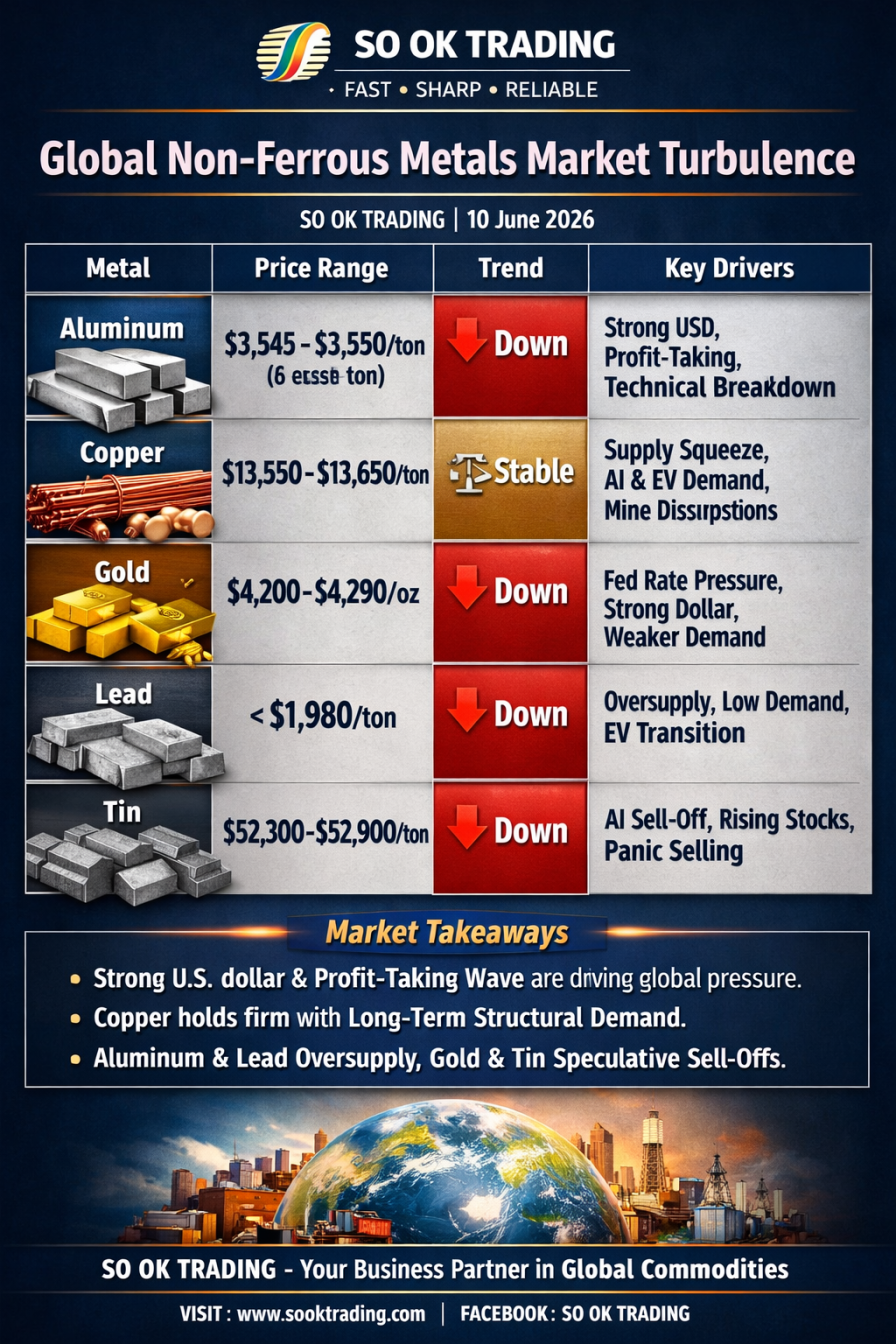
“Global Non-Ferrous Metals Shake-Up! Strong Dollar + Fed Pressure Trigger Heavy Sell-Off — Aluminum Falls, Tin Plunges, but Copper Holds Firm” SO OK TRADING: 10 June 2026
Last updated: 10 Jun 2026
3359 Views

Global Non-Ferrous Metals Volatility – Aluminum Falls, Copper Holds, Gold, Lead & Tin Plunge
SO OK TRADING | 10 June 2026

This week, the global non-ferrous metals market reflects intense pressure from the economy and capital flows. Each metal shows a different trajectory: aluminum and tin plunged sharply, copper held firm, while gold and lead lost ground.

 
⚡ Aluminum: Sharp Correction Prices dropped to $3,545–$3,550/ton, the lowest in 4 weeks, after recently hitting a 4‑year high of $3,790/ton. Key pressures:

Strong Dollar: U.S. labor data exceeded expectations → Fed may keep rates high → USD strength pressured commodity prices.
Profit-Taking: Aluminum surged over 20% YTD due to Middle East shipping tensions → funds liquidated positions.
Technical Breakdown: Breach below $3,600 triggered stop-loss selling → rapid decline.
For Thai importers, transport premiums must be closely monitored as shipping disruptions remain unresolved, even though lower prices may present buying opportunities.

 
Copper: Strategic Metal Holding Firm Prices held above $13,550–$13,650/ton. Support factors:

Sulfuric Acid Shortage: Middle East supply disruption hit Chilean copper refineries.
Mine Issues: Rising costs, lower ore grades, and environmental restrictions tightened supply.
AI & Clean Energy Megatrends: Data centers, EVs, and smart grids sustain long-term demand.
Strong Technical Support: $13,300–$13,500 zone consistently attracts industrial buyers.
Copper remains the “strategic metal” that institutional investors continue to hold, unlike other metals facing heavy sell-offs.

 
Gold: Losing Momentum Under Fed & Dollar Pressure Prices fell to $4,200–$4,290/oz. Key drivers:

Strong U.S. jobs data → Fed may keep rates high → bond yields surged, pulling money out of gold.
Super Dollar: DXY surged, triggering heavy sell-offs.
Technical Breakdown: Fell below 200-day MA → algorithmic trading accelerated selling.
Demand Cooling: Central bank purchases slowed; Chinese jewelry demand dropped ~9%.
If gold fails to hold current support, it risks sliding to $4,100/oz.

 
⚙️ Lead: Oversupply & EV Transition Prices fell below $1,980/ton, after peaking at $2,028/ton just weeks earlier. Key pressures:

LME Stocks surged past 310,000 tons → clear oversupply.
Seasonal Low Demand: June is a low season for battery replacement in the Northern Hemisphere.
EV Transition: Lithium-ion batteries reduce lead demand.
Strong Dollar + sector-wide sell-offs added pressure.
Next supports: $1,950 and $1,920/ton.

 
Tin: Most Volatile Metal Prices plunged over 5% to $52,300–$52,900/ton, after hitting an all-time high of $59,000/ton earlier in June. Key drivers:

Strong Dollar: Fed stance hit liquidity.
AI Tech Sell-Off: Tin surged +36% YTD on solder demand for AI chips → funds liquidated positions.
LME Stocks Rising: Inventories climbed near 8,760 tons → eased supply fears.
Panic Selling: Breach below $55,000 triggered algorithmic liquidation.
Tin remains the most volatile metal in the non-ferrous group.

 
Summary
Aluminum & Lead: Pressured by heavy selling and oversupply → importers must manage costs and transport premiums carefully.
Copper: Supported by long-term strategic demand → standout performer.
Gold: Weakened by Fed pressure and strong dollar → risk of further decline.
Tin: Highly volatile due to speculation and small market size → requires risk management.
Key Insight: “Strong Dollar + Profit-Taking” are the dominant global pressures, but Copper continues to shine as the strategic metal of the AI and clean energy era.

 
SO OK TRADING — Your Trusted Business Partner FAST • SHARP • RELIABLE www.sooktrading.com Facebook: SO OK TRADING

Related Content
“Global Trade Truce 2026: Trump–Xi Negotiation Game and the New Balance of World Economy”   September 23–25, 2026 | Key Insights by SO OK TRADING
Trade Truce & Global Tensions: US–China Summit September 2026 By SO OK TRADING | September 26, 2026 “From Trade Truce to the Fragile Balance of the Global Economy”
26 Sept 2026
“Non-Ferrous Metals: The New Power Transforming Thai–ASEAN Industries into the EV and Circular Economy Era”   SO OK TRADING | 8 OCT 2026
Non-Ferrous Metals: Trends in Thailand and ASEAN SO OK TRADING | 8 OCT 2026 In 2026, the global metals industry is entering a “structural transformation era.” Non-Ferrous Metals — including aluminum, copper, zinc, tin, and nickel — have become the driving force behind the green economy and future technologies. Thailand, as the Downstream Hub of ASEAN, is accelerating the development of electric vehicles (EV), clean energy, and digital infrastructure. These metals are now recognized as strategic raw materials essential to sustaining global economic growth. At the same time, ASEAN is shifting from being a traditional “raw material exporter” to a Global Strategic Hub, powered by carbon neutrality policies, circular economy initiatives, and investments in advanced technologies to ensure long-term sustainability. This article by SO OK TRADING explores the key trends shaping the Non-Ferrous Metals market in Thailand and ASEAN — from the rise of EVs and clean energy, to industry responses to supply shocks, and the creation of circular supply chains that are becoming the “key to the future” of the global metals industry. SO OK TRADING: FAST • SHARP • RELIABLE Your trusted partner in the new era of metals
8 Oct 2026
ทิศทางการใช้ อลูมิเนียมในอนาคต (ปี2026) , ทิศทางราคาอลูมิเนียม และ สถานะการณ์ Carbon Footprint
ทิศทางในอนาคตของอลูมิเนียมไทยมุ่งเน้น ความยั่งยืน (Sustainability) และ เทคโนโลยีขั้นสูง (Advanced Technology) โดยจะเน้น อลูมิเนียมคาร์บอนต่ำ และ อลูมิเนียมรีไซเคิล เพื่อตอบโจทย์อุตสาหกรรมยานยนต์ไฟฟ้า (EV) และการก่อสร้างที่เป็นมิตรต่อสิ่งแวดล้อม พร้อมพัฒนา การเคลือบผิวใหม่ๆ และระบบเศรษฐกิจหมุนเวียน (Circular Economy) เช่น โครงการ Aluminium Loop เพื่อลดต้นทุน เพิ่มมูลค่า และรักษาความสามารถในการแข่งขันในตลาดโลก. แนวโน้มสำคัญ: การเติบโตในอุตสาหกรรมยานยนต์ไฟฟ้า (EV): รถ EV ต้องการใช้อลูมิเนียมเพิ่มขึ้นมากเพื่อลดน้ำหนัก ช่วยประหยัดพลังงานและเพิ่มระยะทางวิ่ง. ความต้องการอลูมิเนียมคาร์บอนต่ำ (Low-Carbon Aluminium): ตอบสนองมาตรการสิ่งแวดล้อมทั่วโลก (เช่น EU CBAM) โดยเฉพาะการใช้อลูมิเนียมรีไซเคิลสูง ซึ่งลดการปล่อยคาร์บอนได้มาก. เศรษฐกิจหมุนเวียน (Circular Economy): โครงการอย่าง "Aluminium Loop" ขับเคลื่อนการรีไซเคิลบรรจุภัณฑ์อลูมิเนียมครบวงจร เพื่อลดขยะและสร้างมูลค่า. นวัตกรรมการเคลือบผิว (Coating Innovations): การเคลือบผิวแบบใหม่ๆ เพื่อเพิ่มฟังก์ชัน เช่น ป้องกันแบคทีเรีย (Anti-microbial) ทำความสะอาดง่าย (Easy-to-clean) สร้างผิวสัมผัสใหม่. การก่อสร้างแบบสำเร็จรูปและโมดูลาร์ (Modular Construction): ใช้อลูมิเนียมมากขึ้นในการผลิตชิ้นส่วนสำเร็จรูปนอกสถานที่ เพื่อความแม่นยำและลดของเสีย. การบูรณาการพลังงานหมุนเวียน (Renewable Energy): ใช้อลูมิเนียมในโครงสร้างรองรับแผงโซลาร์เซลล์ และระบบพลังงานสะอาดอื่นๆ. ความท้าทาย: ต้นทุนพลังงาน & ห่วงโซ่อุปทาน: ความผันผวนของราคาพลังงานและความท้าทายในห่วงโซ่อุปทาน. การแข่งขัน: ประเทศคู่แข่งเร่งพัฒนาเทคโนโลยีรีไซเคิล ทำให้ไทยต้องพัฒนาต่อเนื่องเพื่อรักษาผู้นำ. โอกาส: ไทยมีศักยภาพด้านแรงงานฝีมือ และอุตสาหกรรมต้นน้ำ-กลางน้ำ-ปลายน้ำที่ครบวงจร. การปรับตัวสู่การผลิตคาร์บอนต่ำสร้างโอกาสทางธุรกิจใหม่ๆ โดยเฉพาะการเป็นผู้นำด้านอลูมิเนียมรีไซเคิล. สรุป: อลูมิเนียมไทยจะก้าวสู่ยุคใหม่ที่เน้น "เขียว" (Green) และ "ฉลาด" (Smart) โดยการรีไซเคิลและเทคโนโลยีจะเป็นหัวใจสำคัญในการสร้างการเติบโตและความยั่งยืน.
16 Dec 2025
This website uses cookies for best user experience, to find out more you can go to our Privacy Policy and Cookies Policy
Powered By MakeWebEasy Logo MakeWebEasy