Share

SO OK INSIGHT: Global Oil Prices Plunge – When Geopolitics Reshapes the Industrial World (27 May 2026)
Last updated: 27 May 2026
3383 Views

 Global Crude Oil Prices Plunge – Geopolitical Easing and Industrial Commodity Impact SO OK TRADING : May 27, 2026

 
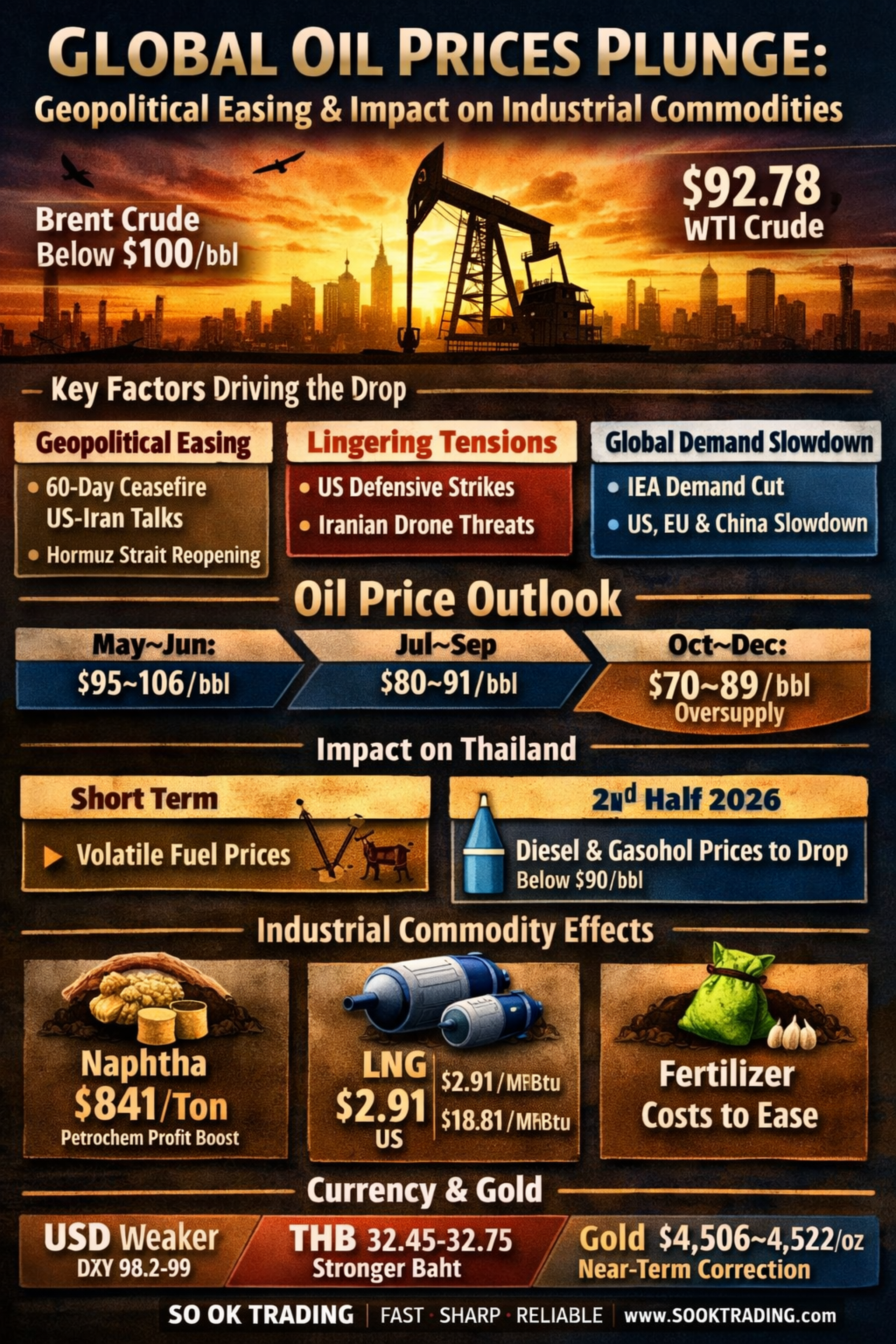
Global Oil Market Movement Crude prices have dropped to a 5‑week low. Brent fell below $100/barrel, while WTI stood at $92.78/barrel. Progress in U.S.–Iran peace talks has raised hopes for reopening shipping routes through the Strait of Hormuz.

 
⚖️ Key Drivers Behind Price Movements

Geopolitical Easing

U.S. and Iran agreed to extend a ceasefire for another 60 days
Talks on mine clearance and reopening Hormuz shipping lanes
Supply pressure eased, market concerns reduced
Tensions Not Fully Resolved

U.S. military continues defensive strikes
Iran claims to have intercepted drones and F‑35 fighters
Fragility remains, prices could rebound anytime
Global Demand Slowdown

IEA downgraded oil demand forecast for this year
Economic slowdown in U.S., Europe, and China → consumers cut oil use and shift to alternative energy
 
Crude Oil Price Outlook

May–June: $95–106/barrel
July–Sept: $80–91/barrel (after Hormuz reopening)
Oct–Dec: $70–89/barrel (oversupply + economic slowdown)
 
Impact on Thailand

Short Term: Retail fuel prices remain volatile as the Oil Fund collects more to restore liquidity
Second Half: If global prices stay below $90, diesel and gasohol prices in Thailand will gradually decline
 
️ Ripple Effects on Other Commodities

Naphtha: Slumped to $841.35/ton → boosts profits for Thai petrochemical sector
Natural Gas (LNG): Stable at low levels – U.S. $2.91/MMBtu, Asia $18.81/MMBtu
Chemical Fertilizers: Prices remain high, but production costs are falling. Continued oil & gas weakness could pressure finished fertilizer prices in H2
 
Currency and Gold Market

U.S. Dollar Index (DXY): Down to 98.2–99 points (geopolitical risk easing)
Thai Baht: 32.45–32.75 per USD → potential further appreciation if oil prices decline
Gold (Spot): $4,506–4,522/oz → short‑term correction, but long‑term uptrend. If peace deal materializes, gold may dip further
 
Summary This oil price drop is not only positive for consumers but also an opportunity for energy, petrochemical, and the Thai economy to benefit from lower energy costs. At the same time, investors must remain alert to geopolitical fragility and OPEC+ policy shifts that could change the game at any moment.

 
SO OK TRADING : Your Business Partner SO OK TRADING : FAST SHARP RELIABLE

VISIT US AT : WWW.SOOKTRADING.COM FACEBOOK : SO OK TRADING

Related Content
HNY 2026 with a First Analysis on Thai Baht Value
he Thai baht in Q1 2026 is expected to strengthen against the US dollar, driven primarily by a weaker dollar globally, a seasonal tourism boost, and expectations of US Federal Reserve rate cuts. This strength is occurring despite a weak domestic economic outlook and the Bank of Thailand's (BoT) likely continued easing of its policy rate. Exchange Rate Drivers and Forecast External Factors: The primary driver for the strengthening baht is external, mainly the broad weakness of the US dollar as global markets price in expected Fed rate cuts. The baht is also correlated with global gold prices, which have been climbing. Tourism High Season: The period extending into Q1 2026 is the high season for tourism, which typically brings in foreign currency and supports the baht's value. Policy Divergence: The BoT is expected to continue its easing cycle, potentially cutting the policy rate further to 1.00% by Q1 2026 to stimulate the sluggish domestic economy. This divergence from a potentially less aggressive US Fed in Q1 could support the baht in the short term, though some analysts warn the currency could weaken later in 2026. Forecasts: Projections for 2026 generally place the baht in a range of 30.80–33.00 per US dollar. Some models estimate it could trade around 31.06 by the end of Q1. A persistently strong baht below 31 per US$ is seen as a significant risk to the Thai export and tourism sectors. Key Economic Context Weak Growth: Thailand's economy is expected to slow down to a 5-year low growth rate of around 1.6-1.8% in 2026, pressured by US tariffs, global trade tensions, and high household debt. The central bank chief expects an improvement in Q1 2026 after a weak second half of 2025. Political Uncertainty: A general election expected in February 2026 could also introduce volatility, though some historical trends suggest the baht may strengthen following the formation of a new government. Low Inflation: Headline inflation is projected to remain subdued or even negative, providing the central bank with justification for further rate cuts to stimulate demand. In summary, Q1 2026 is characterized by a strong and volatile baht driven by external factors, contrasting sharply with a weak domestic economy and accommodative monetary policy.
1 Jan 2026
✨ “Mango Sticky Rice: Thailand’s Sweet Delight That Makes the World Smile and Embrace Global Soft Power” ✨
✨ Mango Sticky Rice: Thailand’s Sweet Power Dessert That Makes the World Smile and Embrace Global Soft Power ✨
14 Apr 2026
This website uses cookies for best user experience, to find out more you can go to our Privacy Policy and Cookies Policy
Powered By MakeWebEasy Logo MakeWebEasy