“Aluminum Prices Surge Beyond Boiling Point! Global Supply Shock – In-Depth Outlook on Market Trends & MJP Premium 2026 by SO OK TRADING”
Aluminum Prices Surge to a 4-Year High – Market Outlook, Price Trends, Supply & MJP Premium
Analysis by SO OK TRADING : 27 May 2026
Market Overview
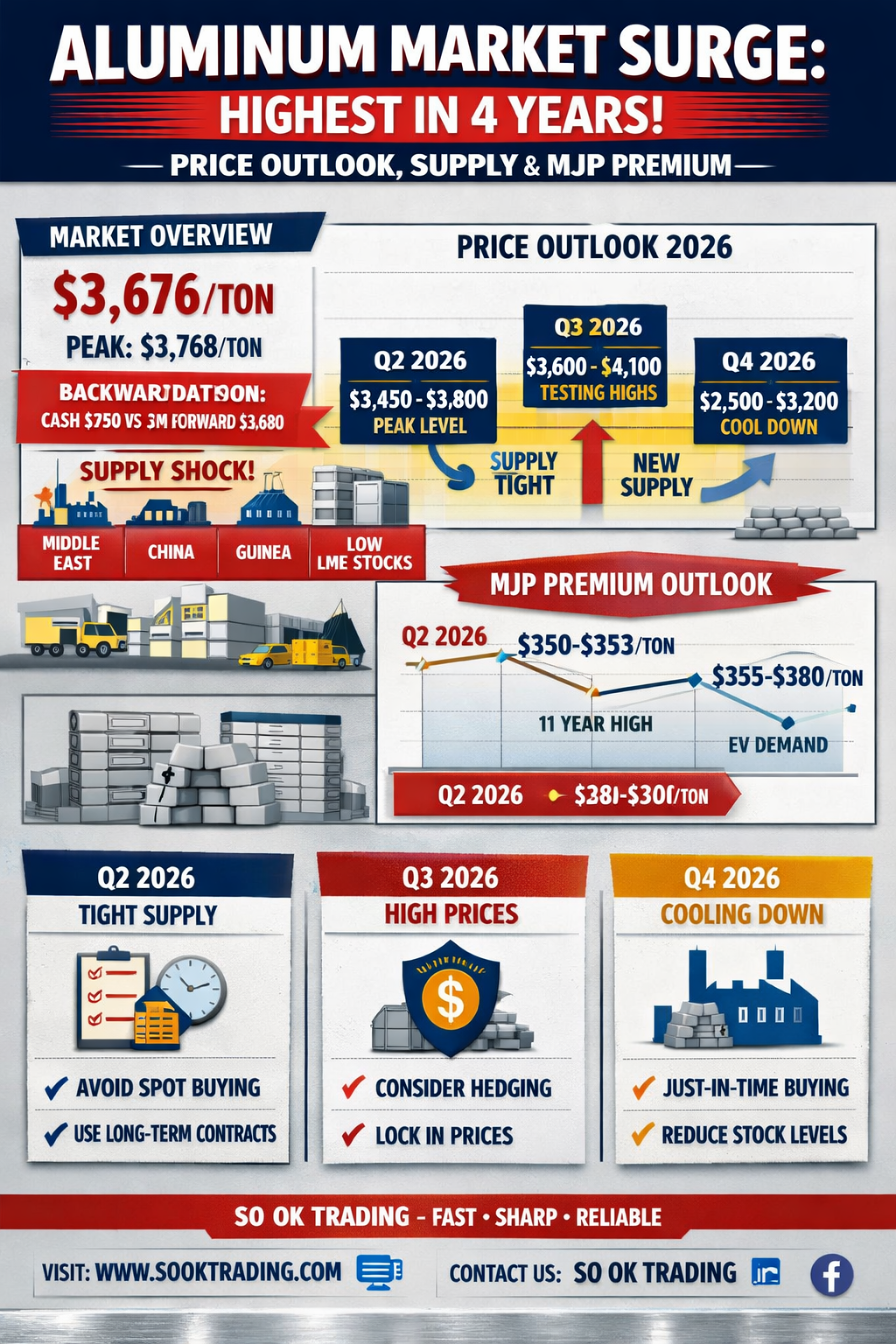
As of 27 May 2026, the global aluminum market is in its “hottest state in years.” The latest price closed at $3,676/ton, with a peak of $3,768/ton. A strong Backwardation has emerged, with cash prices exceeding 3‑month futures by $77, reflecting panic among buyers seeking immediate delivery.
“Although the war is easing, the market still faces a structural supply shock that cannot be recovered in the short term.”
⚙️ Key Price Drivers
Middle East: Major smelters EGA (UAE) and ALBA (Bahrain) severely damaged → 9% of global supply lost.
China: Aluminum production in Guangxi restricted by environmental policies → global supply tightens further.
Guinea: Export quotas on bauxite begin in June → raw material costs surge, alumina supply insufficient.
LME Stocks: Down to 339,350 tons → intensifying pressure on the cash market.
Price Analysis & Market Outlook
Q2/2026 (Current – June)
Price Range: $3,450 – $3,800/ton
Trend: Strong upward (Peak)
Analysis: Damage at EGA requires long-term repair, driving demand for immediate aluminum. Cash price $3,750 vs 3‑month futures $3,680 → short-term upside remains.
Q3/2026 (July – September)
Price Range: $3,600 – $4,100/ton
Trend: High-level consolidation / potential new peak
Analysis: CRU forecasts prices may break $4,000/ton as Guinea’s export limits and China’s environmental quotas fully impact supply.
Q4/2026 (October – December)
Price Range: $2,500 – $3,200/ton
Trend: Cooling down (Correction)
Analysis: Goldman Sachs expects new supply from Indonesia and India to ease market tightness and rebalance.
MJP Premium (Main Japanese Ports) Outlook
Q2/2026: $350 – $353/ton → highest in 11 years
Q3/2026: $355 – $380/ton → supported by EV and industrial demand
Q4/2026: $280 – $320/ton → easing as new supply enters
Import Cost for Thai Industry
As of 27 May 2026, CIF import cost for aluminum ingot has surged to 138,000 THB/ton.
Summary
2026 is dubbed the “Year of the Most Expensive Aluminum in Recent Years.” Prices will soar in Q2–Q3 before cooling in Q4. Businesses must adopt proactive purchasing strategies, leverage forward contracts, and adjust inventory management quarterly to control costs and mitigate risks in the most volatile market of the decade.
Contact Us
Interested in Aluminum Ingot or Aluminum Scrap? Please contact SO OK TRADING.
SO OK TRADING: Your Trusted Business Partner FAST • SHARP • RELIABLE
www.sooktrading.com Facebook: SO OK TRADING