Share

“Global Oil Shock! Prices Skyrocket – Cost of Living Under Pressure, Stagflation Risks 2026” SO OK TRADING | May 19, 2026
Last updated: 19 May 2026
1177 Views

 Global Oil Shock! Prices Surge – Cost of Living Under Pressure Stagflation Fears | SO OK TRADING | May 19, 2026

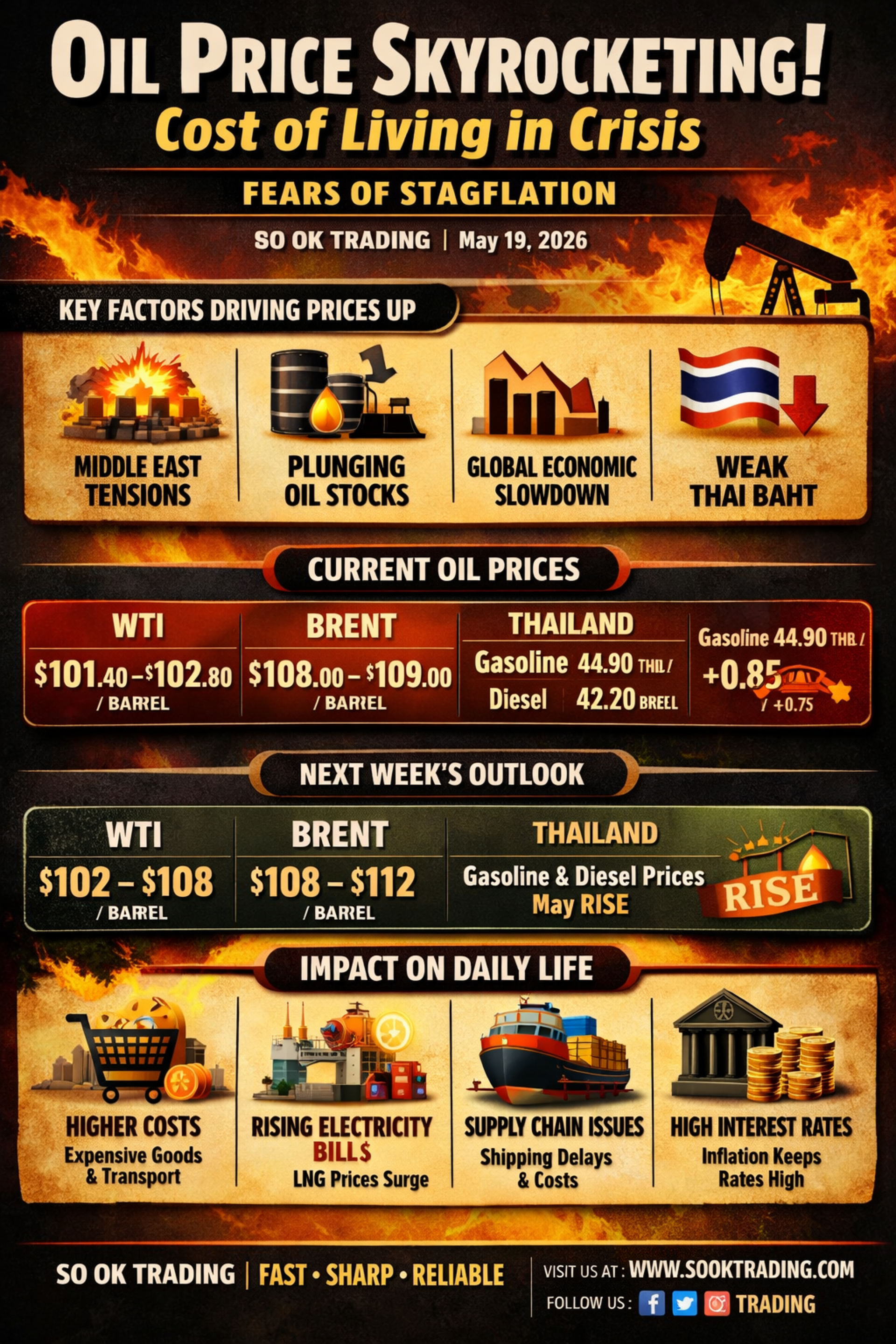
The global oil market is entering its most heated phase in years. Both WTI and Brent crude prices remain elevated under multiple pressures: prolonged Middle East tensions, the fastest decline in global crude inventories on record, and a slowing world economy. As a result, retail fuel prices in Thailand have spiked immediately.

 
Key Drivers Behind Rising Oil Prices (Impact on Thailand)
Middle East Conflict: Renewed U.S.–Iran tensions trigger market panic
Global Stock Decline: Strait of Hormuz disruptions cut supply sharply
Global Economic Slowdown: IMF lowers global GDP forecast to 3.1%
Weak Thai Baht: Higher import costs push up refinery prices
 
Latest Prices (May 19, 2026)
WTI: $101.40 – $102.80 per barrel
Brent: $108.00 – $109.00 per barrel
Thailand: Gasoline 44.90 THB/L (+0.85) | Diesel 42.20 THB/L (+0.75)
 
Next Week’s Outlook (May 25–29, 2026)
WTI: $102–108 per barrel
Brent: $108–112 per barrel
Thailand: Gasoline/Ethanol blends may rise another 0.30–0.50 THB/L; Diesel likely stable due to Oil Fund subsidies
 
⚠️ Impact on Daily Life & Stagflation Risks
Higher Living Costs: Transport and production costs drive consumer prices up
Rising Electricity Bills: LNG prices surge alongside oil, affecting Ft charges
Supply Chain Disruptions: Delays and higher shipping costs through the Middle East
Persistently High Interest Rates: Energy-driven inflation prevents central banks from easing rates
 
Tips for Fuel Users
Refill midweek; if Brent stays above $110, another price hike is likely
Logistics operators should monitor the government’s “Thai Helps Thai Plus” program for energy cost relief
 
Summary
Global oil prices remain in a Sideway Up trend—high and volatile. While peace talks show early signs, supply remains tight, keeping Thailand’s retail fuel prices at risk of further increases. The burden on living costs and the economy will gradually intensify throughout the second half of the year.

 
SO OK TRADING — FAST • SHARP • RELIABLE www.sooktrading.com Facebook: SO OK TRADING

Related Content
HNY 2026 with a First Analysis on Thai Baht Value
he Thai baht in Q1 2026 is expected to strengthen against the US dollar, driven primarily by a weaker dollar globally, a seasonal tourism boost, and expectations of US Federal Reserve rate cuts. This strength is occurring despite a weak domestic economic outlook and the Bank of Thailand's (BoT) likely continued easing of its policy rate. Exchange Rate Drivers and Forecast External Factors: The primary driver for the strengthening baht is external, mainly the broad weakness of the US dollar as global markets price in expected Fed rate cuts. The baht is also correlated with global gold prices, which have been climbing. Tourism High Season: The period extending into Q1 2026 is the high season for tourism, which typically brings in foreign currency and supports the baht's value. Policy Divergence: The BoT is expected to continue its easing cycle, potentially cutting the policy rate further to 1.00% by Q1 2026 to stimulate the sluggish domestic economy. This divergence from a potentially less aggressive US Fed in Q1 could support the baht in the short term, though some analysts warn the currency could weaken later in 2026. Forecasts: Projections for 2026 generally place the baht in a range of 30.80–33.00 per US dollar. Some models estimate it could trade around 31.06 by the end of Q1. A persistently strong baht below 31 per US$ is seen as a significant risk to the Thai export and tourism sectors. Key Economic Context Weak Growth: Thailand's economy is expected to slow down to a 5-year low growth rate of around 1.6-1.8% in 2026, pressured by US tariffs, global trade tensions, and high household debt. The central bank chief expects an improvement in Q1 2026 after a weak second half of 2025. Political Uncertainty: A general election expected in February 2026 could also introduce volatility, though some historical trends suggest the baht may strengthen following the formation of a new government. Low Inflation: Headline inflation is projected to remain subdued or even negative, providing the central bank with justification for further rate cuts to stimulate demand. In summary, Q1 2026 is characterized by a strong and volatile baht driven by external factors, contrasting sharply with a weak domestic economy and accommodative monetary policy.
1 Jan 2026
“Durian Thailand 2026: The King of Thai Durian, A Flavor Loved Worldwide, Winning the Heart of the Dragon (Chinese)”
“Durian Thailand 2026 – The King of Fruit Winning China’s Heart” SO OK TRADING | 20 MAY 2026 This season, Thai durian is more than just a fruit — it is a symbol of quality and luxury, showcasing leadership in the Chinese market
20 May 2026
Trump 2.0: The Tariff Game Isn’t Over The Supreme Court halts global tariffs — but Trump strikes back instantly! Old tariffs are gone, new ones arrive: a fresh 10% global tariff kicks in on February 24, 2026. How much will this hit our wallets? Stay tuned
February 20, 2026 – The day “Global Tariffs” were halted by the U.S. Supreme Court But the game isn’t over… President Donald Trump strikes back with a brand-new 10% global tariff! Dollar weakens Gold surges Stock markets rebound Currencies swing worldwide Precious metals return as Safe Haven The full article by SO OK TRADING analyzes the impact on the global economy, currencies, equities, and safe-haven assets — plus strategies to navigate the coming era of High Volatility. Check out the English Infographic summary Interested in agricultural products, industrial goods, or clean energy fuels? Contact us directly: www.sooktrading.com sooktrading@outlook.com
21 Feb 2026
This website uses cookies for best user experience, to find out more you can go to our Privacy Policy and Cookies Policy
Powered By MakeWebEasy Logo MakeWebEasy