Share

“Copper Cathode 2026–2030: The Strategic Metal of the AI Era and Clean Energy” BY SO OK TRADING|1 MAY 2026
Last updated: 1 May 2026
1263 Views

“Copper Cathode 2026–2030: The Strategic Metal of the AI Era and Clean Energy” By SO OK TRADING|1 MAY 2026

 
What is Copper Cathode and Why is it Important?
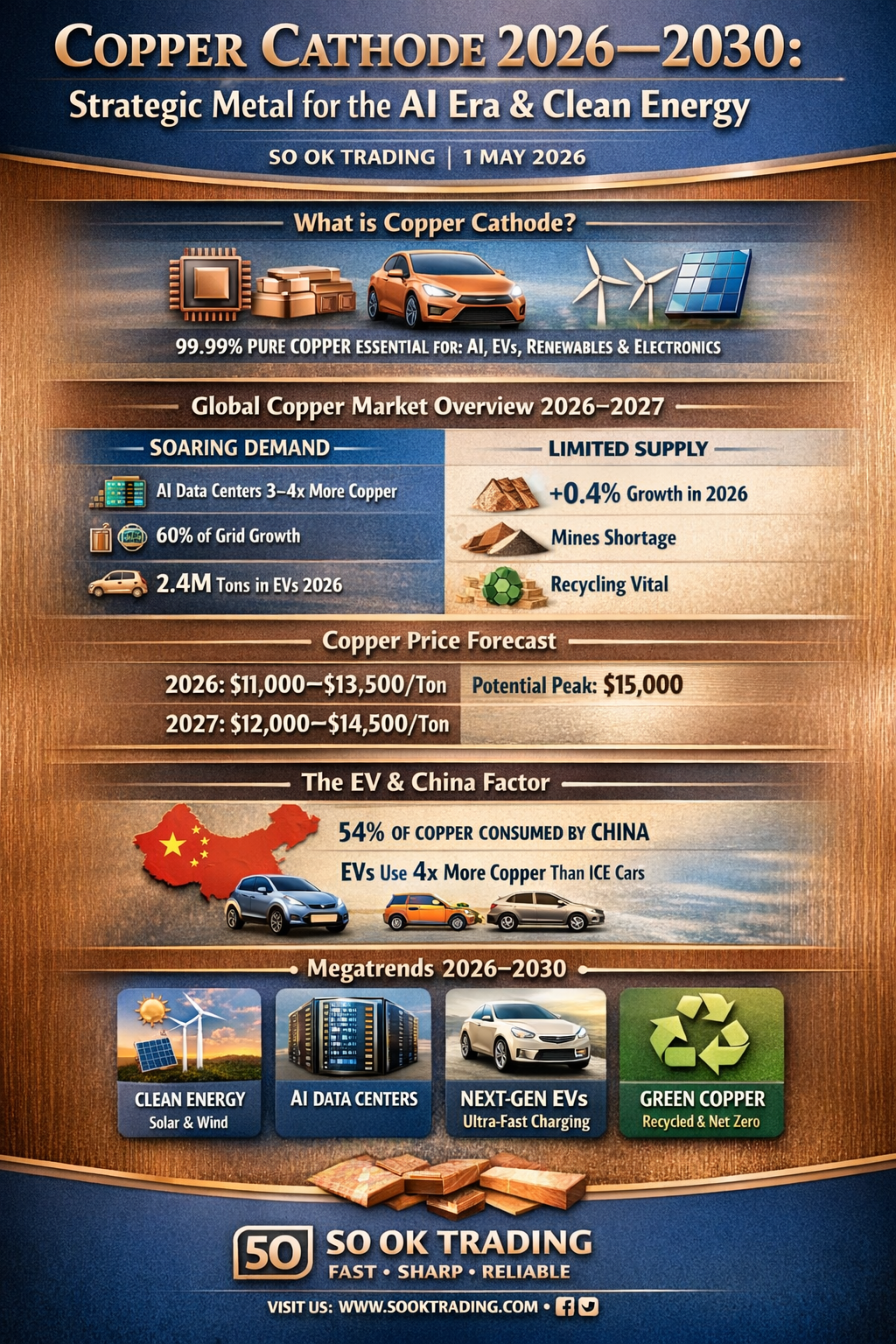
Copper Cathode is 99.99% pure copper, recognized as the core raw material of the modern world. It is used in everything from electrical wiring and circuit boards to EV batteries. Its unmatched conductivity and durability make it irreplaceable compared to other metals.

 
Global Copper Market Overview (2026–2027)
Soaring Demand:

AI Data Centers consume 3–4 times more copper than traditional data centers
Grid infrastructure accounts for over 60% of growth
EVs use an average of 83 kg per car, totaling 2.4 million tons in 2026
Limited Supply:

2026 growth only 0.4% due to concentrate shortages
2027 recovery of 3% from new projects such as Tía María (Peru)
Recycling (Secondary Copper) plays a vital role
 
Copper Price Forecast (SO OK TRADING)
2026: $11,000–13,500/ton (potential peak $15,000)
2027: $12,000–14,500/ton
 
Current Global Market Situation
China and EVs: The Game-Changers

China consumes 54% of global copper cathode
EVs use nearly 4 times more copper than ICE cars
China invests in mines worldwide to secure supply chains (especially in Congo, Africa)
Even with battery designs reducing copper use, high-performance motors and EV wiring still require significant copper
 
Major Trends 2026–2030
Clean Energy: Solar, wind, grid, and ESS driving copper demand
AI & Data Centers: Demand growing at 15–20% CAGR
Next-Gen EVs: Ultra-fast charging and heavy-duty EVs require more copper
Circular Economy: Green Copper from recycling and renewable energy
Direct Sourcing: EV and tech manufacturers sign direct contracts with smelters
 
♻️ Green Copper: From “Option” to “Mandatory Standard”
Produced with renewable energy, net zero, and carbon capture
New technologies: Hydrogen smelting, bio-leaching, recycling innovation
“Green Premium” paid by Apple, Tesla, BMW
EU CBAM enforcement → Green Copper becomes a trade advantage
 
Thailand and Copper Cathode
PCB Hub (ASEAN): Thailand produces 4.7% of global output
EV Hub: 125,000 BEVs annually, consuming massive copper volumes
Exports: Copper tubes and wires expanding into India and the Middle East
Prices: Historic highs at $13,200–14,500/ton
Imports: Thailand relies on pure copper from Africa and South America worth $5.3 billion
2027: CBAM pressures Thai producers to adopt Green Copper to maintain export markets
 
Summary: Copper Cathode Outlook
Copper Cathode is shifting from a “common industrial metal” to a “strategic metal” powering both the digital economy and clean energy. Demand continues to rise while supply remains constrained, driving prices higher and intensifying recycling. Players who transition to Green Copper will gain competitive advantage in the global market.

 
SO OK TRADING: Your Business Partner FAST|SHARP|RELIABLE Visit: www.sooktrading.com Facebook: SO OK TRADING

Related Content
Aluminum Recycling the Circle and How it work
Aluminium is the most abundant metal in the earth’s crust. Approximately 75% of aluminium ever produced is still in use today as it can be recycled endlessly without compromising any of its unique properties or quality. Aluminium’s lifecycle provides significant benefits through recycling, saving 95% of the energy it would take to make new aluminium metal. More information on recycling may be found here. Recycling aluminium has five steps: Step 1: Collecting Scrap There are two categories of aluminium scrap: New Scrap New Scrap is surplus material that arises during the manufacture and fabrication of aluminium products, up to the point where they are sold to the final consumer. For example, off cuts of aluminium sheet or extrusions are considered new scrap. Sometimes, this new scrap can be safely recycled by aluminium smelters as its composition is known. Old Scrap Old Scrap is material that has been used by the consumer and subsequently discarded. For example, used beverage cans, window frames, electrical cabling and car cylinder heads are all considered old scrap. Aluminium smelters are unable to safely accept this old scrap as its composition is usually unknown and it can be contaminated. Scrap aluminium is also collected from the community – from households, scrap merchants, local and regional authorities, etc. Step 2: Sorting Scrap The scrap is then sorted – grouping all coated (painted or lacquered) aluminium together, and grouping all uncoated aluminium together. Paper, plastic and other non-aluminium recycling needs to be removed. Step 3: Crushing The sorted aluminium is then crushed into bales – by compacting the aluminium scrap, it reduces freight, storage and handling costs Step 4: Remelting Uncoated scrap is loaded directly into a large furnace called a remelter, where it is heated at high temperatures and turned into molten form. If the scrap aluminium is coated, it is processed through a gas fired rotary furnace to remove any coating and then transferred to the remelter. Step 5: Casting The molten aluminium is cast at a temperature of just over 700°C to form ingots
13 Nov 2025
“RDF-3: Transforming Cement Plants Towards Clean Energy — The Net Zero Survival Strategy  Article by SO OK TRADING (March 15, 2026)”
RDF-3: The Waste Fuel Cement Plants Love From waste to clean energy, cement plants worldwide—including Thailand—are shifting from costly coal to RDF, cutting costs and carbon emissions in a serious way. RDF-3 (Fluff RDF) is the star of the industry: small size, fast burning, high calorific value, and zero leftover ash. Global Trends: China, Japan, and South Korea are moving toward premium SRF with advanced smart-sorting technology. Thailand is catching up fast: Major cement plants target 50–100% RDF usage, backed by “Trash-to-Cement” models and the new TIS RDF standard. RDF-3 is not just an “alternative fuel” — it’s the fuel of the future, helping cement plants truly go green.
15 Mar 2026
This website uses cookies for best user experience, to find out more you can go to our Privacy Policy and Cookies Policy
Powered By MakeWebEasy Logo MakeWebEasy