Share

“The Energy War the World Cannot Escape: Hormuz Strait Crisis 2026 — A Global Economic Gamble and the ISLAMABAD Conference Negotiations” April 17, 2026 | Article by SO OK TRADING
Last updated: 17 Apr 2026
212 Views

“The Hormuz Strait Crisis Shakes the Global Economy”
ISLAMABAD Conference Round 2: Negotiation Outcomes and Scenario Analysis SO OK TRADING – April 17, 2026

 
The Strait of Hormuz is the lifeline of global energy. More than one-fifth of the world’s oil and gas must pass through this route. But when the confrontation between the United States and Iran escalated into a blockade, this lifeline nearly stopped flowing—and the entire world trembled.

 
The Beginning of the Crisis: February 28, 2026 – U.S. Attack on Iran
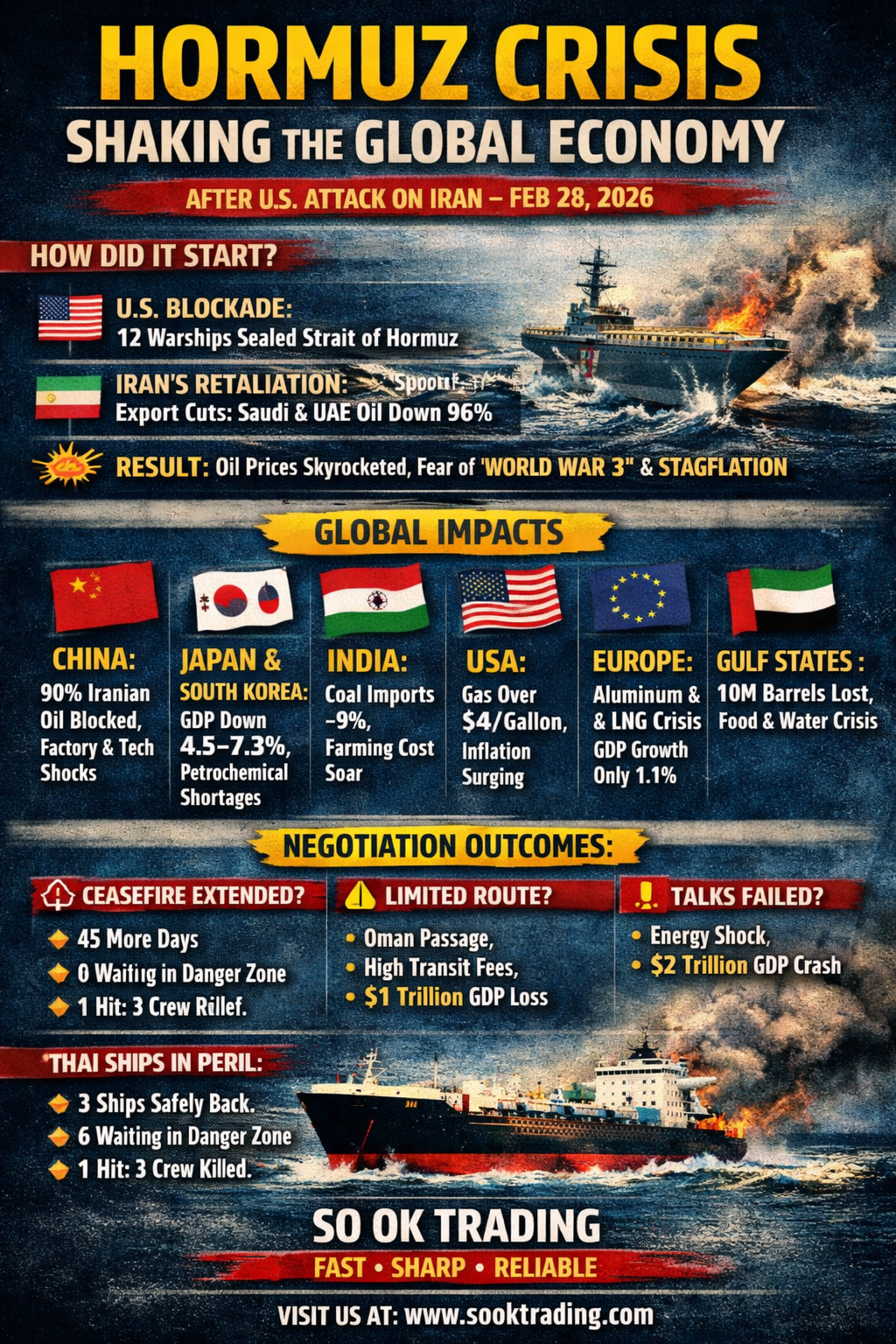
U.S. Blockade: After peace talks collapsed, more than 12 U.S. Navy ships sealed off the strait.
Iran’s Response: Restricted navigation, cutting Saudi and UAE oil exports by over 96%. The world faces severe oil shortages.
Immediate Impact: Energy prices surged, and warnings grew louder that this could spiral into “World War III” and trigger global stagflation in 2026.
 
Global Impact
China: Hit hardest, as over 90% of Iran’s oil exports go to China. With the route blocked, China considers deploying warships to protect its shipments. Manufacturing and technology risk immediate disruption.
Japan & South Korea: Highly dependent on oil and LNG, also facing shortages of naphtha, a key raw material for plastics and packaging. Japan has already tapped into strategic reserves; if prolonged, GDP may shrink by 4.5–7.3%.
India: Coal imports down 9%. Rising costs from fertilizer and raw material shortages threaten agriculture and industry.
United States: Less dependent, but retail gasoline prices surged above $4 per gallon. Inflation and political approval ratings shaken.
Europe (EU): Shortages of aluminum and LNG hit automotive and construction industries. Eurozone GDP growth may fall to just 1.1%.
Saudi Arabia & UAE: Oil exports down more than 10 million barrels per day. Revenues collapse, while gas-fired power plants under attack trigger food and water crises.
Thailand: Oil reserves last about 60 days, but electricity prices may soar to 5.7 baht per unit. Nine Thai cargo ships stranded, mostly carrying fertilizer and agricultural goods. Agriculture and industry face steep cost increases.
 
Thai Ships in the Hormuz Blockade
Three ships escaped, including the Serifos, carrying 2 million barrels of crude oil back to Thailand.
Six to seven ships remain stranded, awaiting negotiations via Oman before the ceasefire deadline of April 22.
The Mayuree Naree was attacked, killing three crew members—becoming a symbol of Thailand’s trade vulnerability.
 
Future Scenarios and Global Economic Impact
Ceasefire Extension (High Probability)
Pakistan pushes for a 45-day extension.
If successful, global oil prices ease temporarily.
World GDP losses remain limited, but prolonged negotiations keep risks alive.
Limited Route Opening (Middle Ground Proposal)
Iran proposes rerouting ships through Oman’s waters, with high transit fees.
Trade continues partially, but logistics costs skyrocket.
If sustained for months, global GDP may shrink by about $1 trillion.
Negotiation Failure (Worst Case Scenario)
Without agreement, the world faces the largest energy disruption in history.
IMF and UNCTAD estimate global GDP losses of over $2 trillion if the strait remains closed for three months.
Freight rates surge from $300 to over $8,000 per container on some routes.
Global inflation risks rise, with economic slowdown across all regions.
 
This is not just a “Middle East crisis” but a global crisis—from gas station prices to factory production costs. Every nation must learn: Energy security = Economic and everyday security.

 
SO OK TRADING: Your Business Partner SO OK TRADING: FAST • SHARP • RELIABLE

VISIT US AT : WWW.SOOKTRADING.COM

FACEBOOK : SOOK TRADING


Related Content
“Cassava and Corn: From Food to Green Energy and Bio-Packaging Bioplastics and Clean Fuels — From the Kitchen of the World to the Green Innovation Hub” Article by SO OK TRADING | March 24, 2026
“Transforming Thai Crops to Net Zero: From Cassava and Corn to Bioplastics, Packaging, and Future Fuels” Cassava and corn are no longer just food crops — they are becoming the raw materials of the future for compostable packaging, bioplastics, and clean fuels, driving the green economy and supporting Net Zero goals. This article by SO OK TRADING explores in depth:
24 Mar 2026
Breaking Barriers: Gold’s $5,000 Milestone & Global Outlook
Gold has officially broken the $5,000 barrier — and the world is watching. From central bank demand to geopolitical tension, the bullish cycle is real. Here’s a quick snapshot of what’s driving the surge, what top institutions are forecasting, and how SO OK TRADING helps Thai brands rise with global momentum.
12 Feb 2026
Steel Industry Outlook 2026: Gradual Recovery with Rising Price Potential BY SOOK TRADING
Steel Industry Outlook 2026: Gradual Recovery with Rising Price Potential The year 2026 marks a turning point for the global steel industry. After hitting its lowest point in 2025, the market is entering a “new equilibrium,” with demand gradually recovering and prices showing signs of stable upward movement. Global steel demand is forecast to grow 1.3%, reaching 1,773 million tons. India will be the main driver, with growth of 9% fueled by infrastructure investments in roads, railways, and energy. The United States and Europe are also expected to recover steadily, supported by interest rate cuts, clean energy projects, and the automotive sector—1.8% growth in the US and 3.2% in the EU. China, while still facing a slowdown in real estate, will see demand decline ease to -1%, supported by infrastructure projects and steel exports. Meanwhile, Southeast Asia and the Middle East are expected to contribute to diversified demand growth through infrastructure and energy investments. On the pricing side, steel bars (Rebar) are expected to average 16,000–17,000 THB/ton (450–530 USD/MT). Iron ore costs are projected at 83–95 USD/ton, with new supply from Guinea and Australia helping to stabilize input costs. Although trade barriers in the US and EU may keep domestic prices above global levels, the market is moving toward a more stable balance. In Thailand, steel demand is expected to grow modestly, driven by construction and automotive industries, with a base of 16.2 million tons in 2025. However, cheap Chinese steel could account for up to 50% of the market, putting pressure on local producers. Thai businesses must adapt by developing value-added specialty products, enhancing quality standards, and targeting premium and niche export markets such as ASEAN, the Middle East, and Africa. SO OK Trading: Partnering Thai Steel with Global Markets SO OK Trading supports Thai steel producers with comprehensive solutions: - Market Connectivity: Linking Thai producers with buyers in China and East Asia through an extensive partner network and integrated rail–sea–road logistics. - Market Analysis & Pricing Strategy: Providing insights into steel and iron ore price trends, with index-linked pricing recommendations to reduce volatility. - Stable Contracts & Compliance: Assisting in contract structuring, export documentation, standards, and certifications to ensure reliable trade. - Customer Development: Delivering tailored technical and commercial proposals to meet the needs of Chinese buyers seeking specialty steel. SO OK Trading is more than an exporter—it is a trusted business partner, helping Thai steel enterprises compete with stability and sustainability in the global steel market.
15 Jan 2026
This website uses cookies for best user experience, to find out more you can go to our Privacy Policy and Cookies Policy
Powered By MakeWebEasy Logo MakeWebEasy