“ASEAN Rubber: From Plantations to Factories, Driving Global Economic Transformation into a New Industrial Era” — Article by SOOK TRADING | April 8, 2026
ASEAN Rubber: From Plantations to Global Industry
— Article by SO OK TRADING | April 8, 2026
Introduction
Natural rubber is not just “raw material for tires” — it is the backbone of global industries, from automobiles to medical equipment. ASEAN is the world’s largest production hub, led by traditional producers such as Thailand, Malaysia, and Indonesia, alongside new entrants like Vietnam.
Comparing Rubber from Different Countries
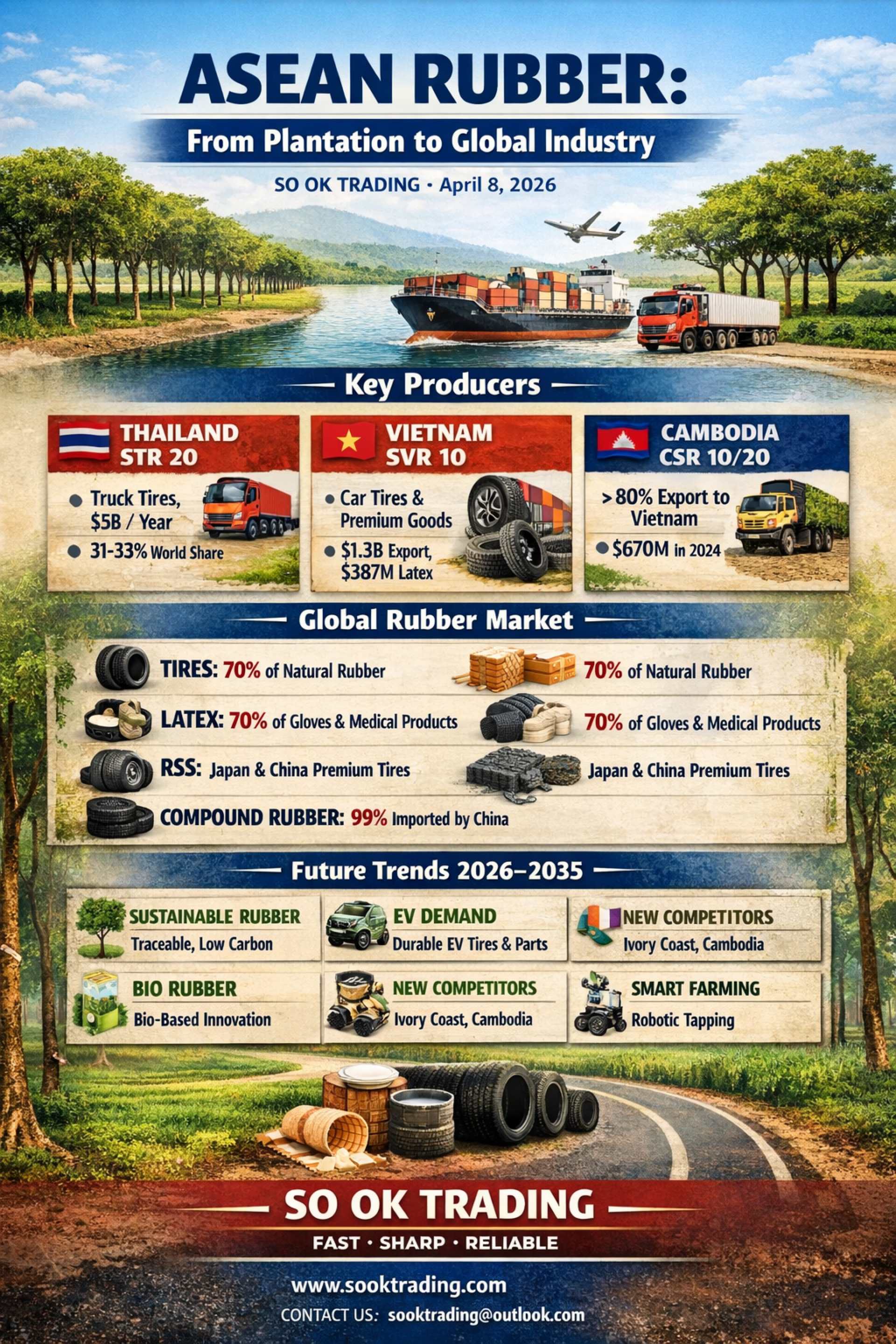
Thailand – STR 20 (TSR20)
Strengths: Cost-effective, massive volume, long-established producer.
Main Markets: Truck tires, bus tires, engineering products.
Market Size: Exports ~USD 5 billion/year, holding ~31–33% of global share.
Role: Serves as the “global standard” grade most widely used by tire factories worldwide due to balanced price and quality.
Vietnam – SVR 10 (VSR10)
Main Markets: Passenger car tires, inner tubes, conveyor belts, premium footwear.
Market Size: Rubber exports ~USD 1.3 billion/year; latex ~USD 387 million.
Role: Targets premium markets requiring durability and elasticity.
Cambodia – CSR 10/20
Main Markets: Exports to Vietnam (over 80%), China, Malaysia, Thailand.
Market Size: In 2024, rubber and rubberwood exports ~USD 670 million.
Role: Transitioning from raw material supplier to establishing domestic tire factories for added value.
Global Rubber Market Applications
Tires: Account for ~70% of global natural rubber use.
Latex: Used in gloves, condoms, medical equipment (Thailand holds ~70% of global share).
RSS (Ribbed Smoked Sheets): Popular in Japan and China for premium tires and conveyor belts.
Compound Rubber: China imports ~99%, mainly for automotive industries.
Future Outlook (2026–2035)
Sustainability Era (EUDR & Green Shift)
Traceable rubber will command higher prices.
Low-carbon rubber will be in demand by global tire manufacturers.
⚡ EV Boom
Electric vehicles require tougher, more durable tires (wearing out 20–30% faster).
Seals and suspension components demand high-quality compound rubber.
Rise of New Producers
Ivory Coast: Emerging competitor with low costs and vast plantations.
Cambodia/Laos: Becoming new raw material bases for Chinese factories.
Bio-based Synthetic Rubber
Progressing rapidly, but cannot fully replace natural rubber — especially for aircraft and heavy truck tires.
Smart Farming
Robotic tapping and disease-resistant varieties will shape the future.
Thailand and Vietnam are accelerating adoption to address labor shortages.
Conclusion
STR20 (Thailand): High volume, cost-effective → Dominates general tire markets (both combustion and EV).
SVR10 (Vietnam): High quality → Expands into premium markets.
CSR (Cambodia): Rising star → Building domestic processing industries.
The global rubber industry is shifting from the “Quantity Era” to the “Quality + Sustainability Era.” Those who adapt quickly and establish traceability systems will emerge as winners in this new industrial game.
SO OK TRADING
Your Trusted Business Partner FAST • SHARP • RELIABLE
Visit us: www.sooktrading.com Contact: sooktrading@outlook.com