Share

“Lead Bullion: Powering Batteries, Forging the Green Energy Future — An Article by SO OK TRADING, April 7, 2026”
Last updated: 7 Apr 2026
908 Views

Lead Bullion & Battery Market: The Metal Power Driving the New Energy World
 
What is Lead Bullion?
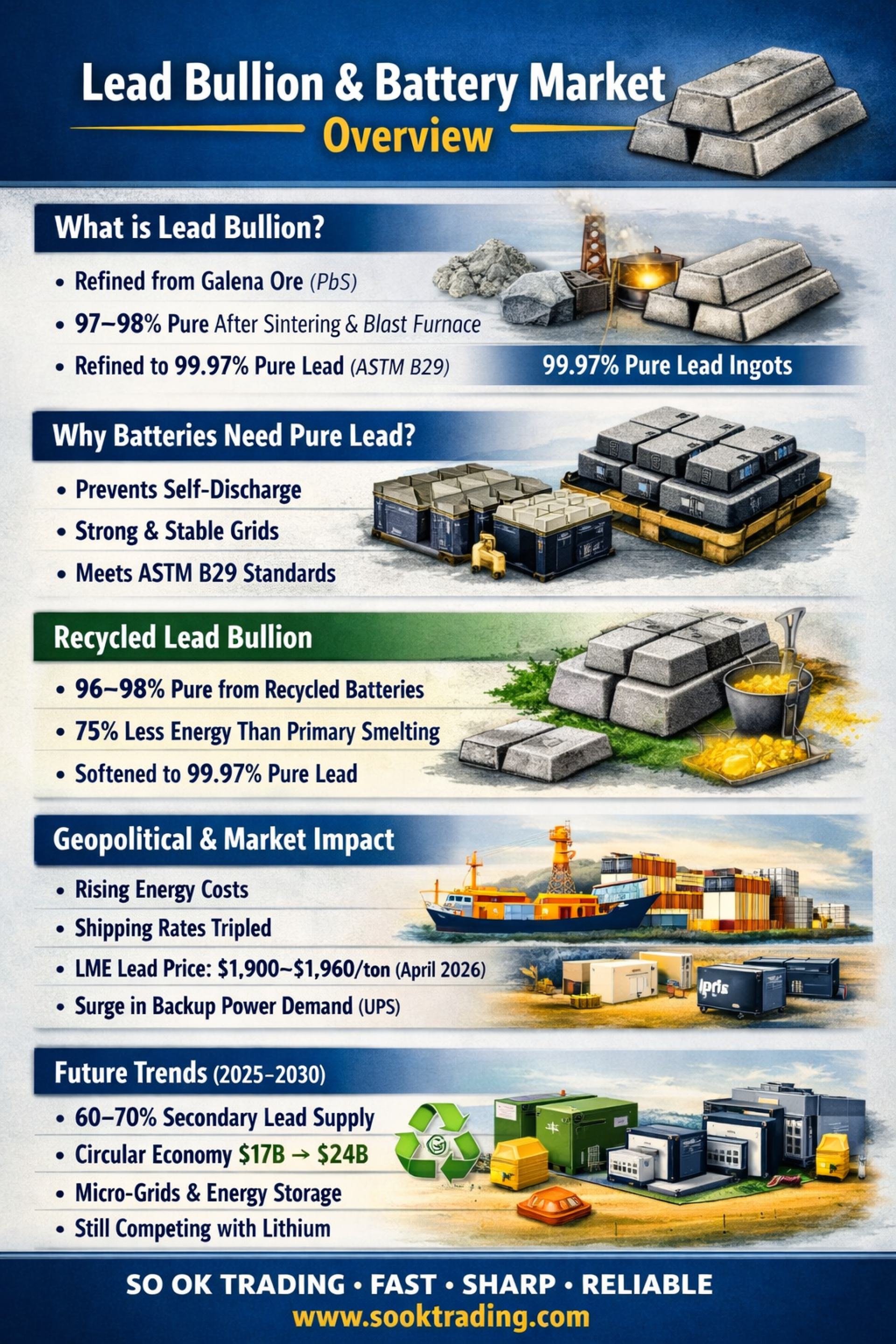
Lead Bullion (crude lead) is produced from Galena ore (PbS) through sintering and blast furnace smelting, with purity around 97–98%. However, it still contains impurities such as silver, copper, antimony, tin, and arsenic. Therefore, it must undergo refining to reach 99.97% pure lead under ASTM B29 standards, before being used in the battery industry.

“Lead Bullion is often cast into large ingots (Ingots or Pigs) for easy transport to refineries.”
 
⚡ Why Do Batteries Require Pure Lead?
Impurities accelerate degradation: Copper or iron cause rapid self-discharge.
Grid strength: Refined lead is often alloyed with antimony or calcium to ensure strong and stable battery grids.
Strict standards: ASTM B29 strictly limits impurities such as antimony, arsenic, and nickel.
 
♻️ Lead Bullion from Battery Recycling
Purity 96–98%, but with high antimony content (1.5–4%).
Softening process: Removes antimony, arsenic, and tin to achieve 99.97% soft lead.
Advantages: Uses 75% less energy compared to primary smelting.
Caution: Poor separation may leave high levels of bismuth, which is difficult to remove and affects battery quality.
 
Geopolitical Factors & Middle East Conflict Impact
Energy prices surge: Refining costs rise immediately.
Freight rates soar: Shipping costs increased 2–3 times after the Strait of Hormuz crisis.
Global market (April 2026): LME lead price at USD 1,900–1,950/ton, with inventories up to 281,000 tons.
Impact on Thailand: Lead prices fell, but electricity and shipping costs rose by 47%.
Opportunity in crisis: UPS battery demand surged in hospitals, data centers, and communication systems.
 
Future Outlook (2025–2030)
Secondary lead dominates: Expected to account for 60–70% of global demand.
Circular economy growth: Lead-acid battery recycling market projected to grow from USD 17B to USD 24B.
Competition with lithium: EVs rely on lithium, but starter batteries and UPS remain lead-based.
Micro-Grid & ESS: Developing countries favor lead batteries for affordability and easy maintenance.
ESG & clean technology: Smelters must adopt emission-reduction technologies, such as hydrogen instead of coke.
 
Lead Bullion Summary
Lead prices down, but energy and shipping costs up → Thai manufacturers must manage costs carefully.
Golden opportunity in UPS market → Geopolitical instability drives demand for lead-acid batteries.
Future is recycling → Closed-loop systems will be the key strategy for sustainable battery production.
Recycled Lead = 75% Cost Savings + ESG Compliance + Circular Economy Solutions

 
SO OK TRADING — FAST • SHARP • RELIABLE We are your trusted business partner, delivering high-quality Lead Bullion and Lead Ingots that meet international standards, supporting the battery industry and renewable energy sectors.

Visit us at: www.sooktrading.com Contact us directly: sooktrading@outlook.com


Related Content
ALUMINUM PRICE TREND 2026
An analysis of the aluminum market in 2026 indicates a likely continued market deficit and upward price pressure, driven by constrained supply and resilient demand from green energy sectors. However, significant volatility is expected due to policy uncertainties and the potential for new Indonesian supply to eventually balance the market. Key Drivers and Projections for 2026 Supply Side Analysis Capacity Constraints: China's primary aluminum output is approaching its self-imposed 45 million-tonne capacity cap, limiting global supply growth. Power Challenges: Smelters outside of China face intense competition for power from energy-intensive sectors like AI data centers, which are willing to pay higher prices for long-term contracts. This has kept significant capacity offline in Europe and the US. Production Disruptions: Outages and potential shutdowns at existing smelters in Iceland and Mozambique further tighten the market. Scrap Supply Pressure: The EU's planned implementation of the Carbon Border Adjustment Mechanism (CBAM) and potential scrap export tariffs in spring 2026 are expected to impact global scrap flows, creating regional shortages and price volatility. New Capacity: Indonesia is a key source of new supply, with several projects in the pipeline. However, analysts suggest the pace of the ramp-up may be slower than expected due to infrastructure and policy challenges, meaning it is unlikely to fully offset near-term tightness. Demand Side Analysis Green Transition Demand: Demand from "green" sectors such as solar panels, new energy vehicles, and energy transition infrastructure remains strong, providing fundamental support for the market. Substitution Effect: Aluminum's wide price discount relative to copper has encouraged substitution in electrical applications, acting as a tailwind for demand and prices. Construction and Automotive: The construction and automotive industries continue to be major consumers, with growing demand for lightweight, low-carbon aluminum products. Price Forecasts and Volatility The market is expected to remain in a deficit in 2026, with estimates ranging from 200,000 to 600,000 tonnes. This structural tightness is leading most analysts to forecast sustained or rising prices. Bullish Views: Analysts at Bank of America project prices of $3,000/tonne as early as 2026. J.P. Morgan also expects prices to approach $3,000/tonne in Q1 2026. ING forecasts an average price of $2,900/tonne for the year. Bearish/Conservative Views: Goldman Sachs is an outlier, forecasting prices to decline to $2,350/tonne by Q4 2026, anticipating a market surplus later in the year. SMM forecasts a "high first, then lower" pattern, with prices finding equilibrium in the $2,700–$2,800/tonne range by year-end. Premiums: Regional premiums, particularly the US Midwest premium, are expected to remain high and volatile due to tariffs and regional supply dynamics, creating a disconnect from the LME benchmark price. In essence, 2026 is projected to be a year of high volatility where participants need to focus on scenario readiness rather than relying on a single price forecast, as geopolitical and energy policies significantly influence regional supply and costs
31 Dec 2025
LME คือ อะไร และ ราคาเคลื่อนไหวอย่างไร และ คาดการณ์อย่างไร
คุณรู้หรือไม่ว่าโลหะ / อโลหะ ที่อยู่รอบตัวพวกเราชนิดอื่นๆ ราคาเดี๋ยวก็ขึ้นเดี๋ยวก็ลงไม่ต่างจากราคาทองเลย รวมถึงราคาของอลูมิเนียม , ทองแดง , สังกะสี , เหล็ก , ตะกั่ว ก็ด้วยเช่นกัน ทำไมราคาอโลหะ เช่น อลูมิเนียม ถึงปรับเปลี่ยนอยู่ตลอดเวลา SO OK อยากชวนคุณมาอ่านบทความนี้ เพื่อ Refresh ข้อมูล และ ทำความเข้าใจกับวงจรการเคลื่อนไหวราคา LME กัน ก่อนอื่นเราขอชี้ให้เห็นก่อนว่าอลูมิเนียม และถูกนำมาใช้ประโยชน์ในหลากหลายอุตสาหกรรม หากมองไปที่ของใช้ต่างๆ รอบตัว เชื่อว่าจะต้องมีหลายชิ้นที่มีส่วนประกอบของอลูมิเนียมแน่นอน เช่น กระป๋องบรรจุเครื่องดื่ม ชิ้นส่วนรถยนต์ กรอบประตูหน้าต่าง เครื่องใช้ไฟฟ้า อุปกรณ์ครัว เป็นต้น นั่นทำให้อลูมิเนียมเป็นที่ต้องการของภาคการผลิตตลอดเวลา ด้วยคุณสมบัติที่มีความแข็งแรงแต่น้ำหนักเบา นำความร้อนและความเย็นได้ดี ที่สำคัญสามารถรีไซเคิลเพื่อนำกลับมาใช้ประโยชน์ใหม่ได้เรื่อยๆ ไม่รู้จบ แต่นั่นก็ขึ้นอยู่กับความต้องการของตลาดและสถานการณ์ในแต่ละประเทศที่เกี่ยวข้องด้วยเช่นกัน จึงทำให้ ราคาอลูมิเนียม ขึ้นลงแปรผันตาม demand และ supply และสถานการณ์ต่างๆ ที่ส่งผลกระทบ แล้วปัจจัยอะไรที่ส่งผลต่อราคา อโลหะ , โลหะ SO OK จะขออนุญาติ ยกตัวอย่างจากสินแร่ อลูมิเนียม มาให้เห็ภาพ เราสามารถเช็กราคาอลูมิเนียมได้โดยอิงจากราคา LME แล้วราคา LME คืออะไร? LME หรือ London Metal Exchange เป็นตลาดแลกเปลี่ยนสินค้าเกี่ยวกับอโลหะ (ไม่รวมเหล็ก) ที่ใหญ่ที่สุดและเป็นที่ยอมรับมากที่สุดจากประเทศอังกฤษ โดยมีสัญญาซื้อขายล่วงหน้าและตัวเลือกต่างๆ สำหรับโลหะและสินค้าโภคภัณฑ์ คือ อลูมิเนียม ทองคำ ทองแดง เงิน โคบอลต์ และสังกะสี ซึ่งเมื่อเทียบราคาทองคำที่ขึ้นลงตลอดเวลาแล้ว ราคาของอลูมิเนียมก็ขึ้นลงไปต่างกัน แต่ก็ปรับตัวขึ้นจากปีก่อนๆ เยอะมาก โดยเมื่อย้อนดูราคาอลูมิเนียมตั้งแต่ต้นปี 2021 จนถึงตอนนี้ NOV 2025 ราคาอลูมิเนียมเคยมีราคาต่ำสุดที่ 1,953.80 ดอลลาร์สหรัฐ/ตัน สูงสุดที่4,300 ดอลลาร์สหรัฐ/ตัน และปัจจุบัน (NOV 2025) เฉลี่ยอยู่ที่ 2,823 ดอลลาร์สหรัฐ/ตัน สาเหตุที่ทำให้ราคาอลูมิเนียมปรับตัวสูงขึ้นในปัจจุบันและมีแนวโน้มสูงขึ้นต่อเนื่องในอีก นั่นก็เพราะว่าประชาชนมีกำลังซื้อมากขึ้นโดยเฉพาะเครื่องใช้ไฟฟ้า , รถไฟฟ้า EV, การใช้งานแบตเตอรี่ไฟฟ้า , บรรจุภัณฑ์ , สายไฟ ภาคอุตสาหกรรมจึงต้องเพิ่มจำนวนการผลิตให้เพียงพอกับความต้องการ ทำให้ผู้ผลิตต้องซื้อวัตถุดิบในตลาดโลกมากขึ้น ราคาวัตถุดิบในตลาดโลกจึงพุ่งสูงขึ้น ยิ่งไปกว่านั้น เทรนด์รักษ์โลกกับการใช้อลูมิเนียมยังมาแรงมากๆ ในปัจจุบัน “เทรนด์โลกกำลังมุ่งเน้นไปสู่เป้าหมายการสร้างความยั่งยืน SDGs ซึ่งมีผลต่อปริมาณความต้องการอลูมิเนียมสูงขึ้นในระยะยาว เพราะหลายประเทศหันมาใช้พลังงานจากแสงอาทิตย์ ซึ่งใช้อลูมิเนียมในการทำโซลาร์เซลล์ ทำให้ปริมาณการใช้อลูมิเนียมในอนาคตจะเพิ่มขึ้น 10 เท่าใน 10 ปี หรือเพิ่มจาก 1 ล้านตันในปี 2563 เป็น 4 ล้านตันในปี 2573” – นายธีรพันธุ์ พิมพ์ทอง ประธานกลุ่มอุตสาหกรรมอลูมิเนียม สภาอุตสาหกรรมแห่งประเทศไทย (ส.อ.ท.), ประชาชาติธุรกิจ, มิ.ย. 21 อ่านมาถึงตรงนี้ก็คงจะเห็นกันแล้วว่าอลูมิเนียม รวมถึงสินค้าโลหะ และ อโลหะอื่นๆ จึงเป็นวัตถุดิบที่มีค่ามากอย่างที่หลายคนคาดไม่ถึงกันเลยทีเดียว ราคาอลูมิเนียมจึงปรับขึ้นลงตลอดเวลา และยังมีแนวโน้มจะปรับตัวขึ้นไปในอนาคตอีกด้วย
29 Nov 2025
This website uses cookies for best user experience, to find out more you can go to our Privacy Policy and Cookies Policy
Powered By MakeWebEasy Logo MakeWebEasy