War • Oil • Dollar: Deep Dive into Thai Baht & Stock Market Q1 2026 and April Outlook in a High-Volatility Era Article by SO OK TRADING April 1, 2026
Currency & Thai Stock Market: Q1 2026 Recap & April Outlook
Article by SO OK TRADING April 1, 2026
In the first quarter of 2026, both the Thai Baht (THB) and the Thai Stock Market (SET Index) faced heavy pressures — from the Middle East conflict and surging oil prices to capital outflows — forcing investors and businesses to adapt and recalibrate their strategies.
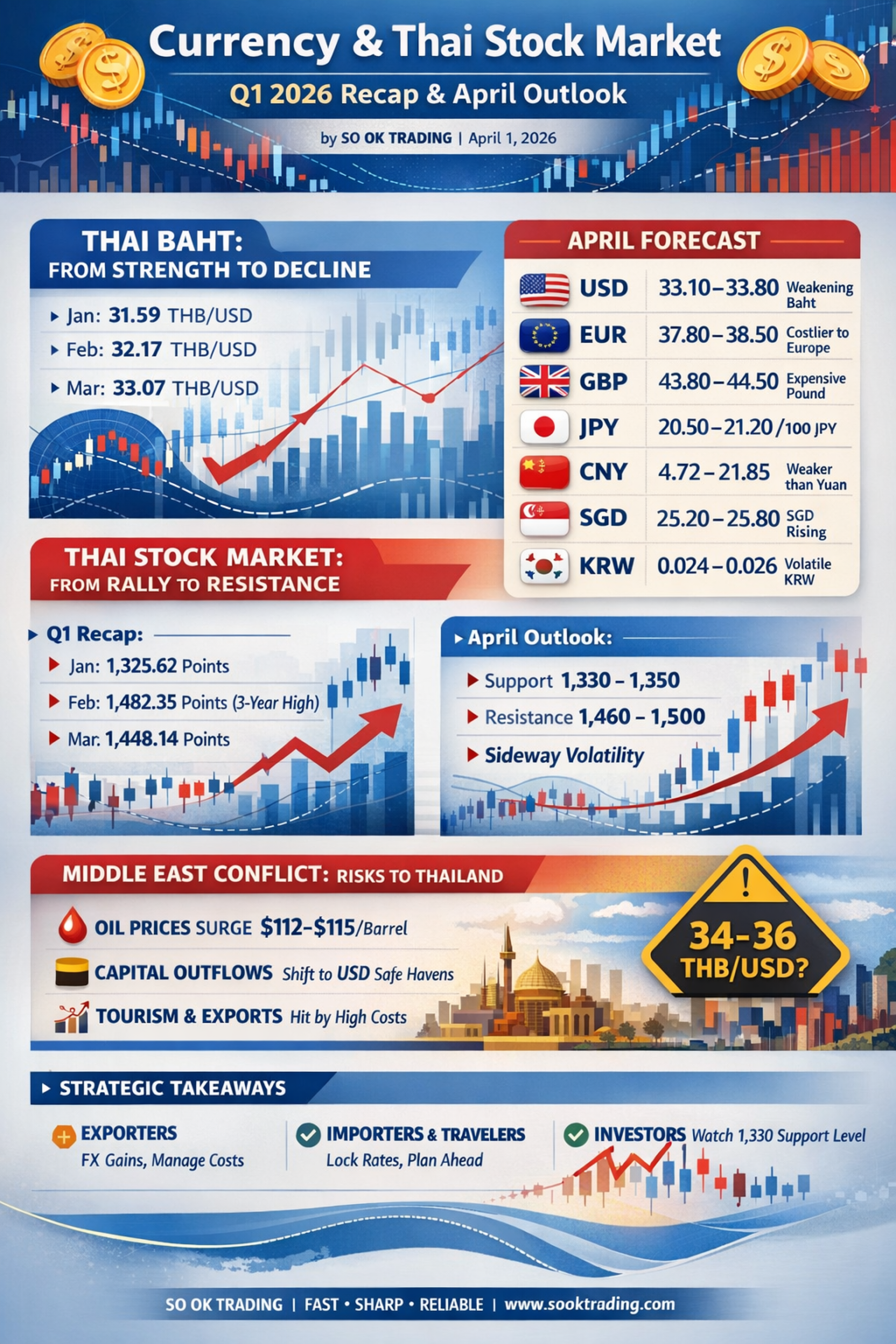
Thai Baht: From Strength to Sharp Weakness
Performance over the past 3 months (Jan–Mar 2026):
January: Average 31.59 THB/USD (strongest in a year)
February: Average 32.17 THB/USD (temporary rebound from capital inflows)
March: Average 32.83 THB/USD, touching 33.07 THB/USD (weakest in 10 months)
April Forecast vs Major Currencies:
USD: 33.10 – 33.80 → Dollar remains strong as a safe haven
EUR: 37.80 – 38.50 → European travel costs rise
GBP: 43.80 – 44.50 → Pound stays expensive
JPY: 20.50 – 21.20 /100 Yen → Yen slightly stronger
CNY: 4.72 – 4.85 → Baht weaker than Yuan
SGD: 25.20 – 25.80 → Reflects USD strength
KRW: 0.024 – 0.026 → Volatile with Korean equities
Summary: The Baht has weakened significantly against USD, EUR, and GBP, raising import costs and overseas travel expenses. Exporters gain some benefit from FX conversions, but rising logistics costs offset the advantage.
Thai Stock Market: From Rally to Correction
Q1 2026 Recap:
January: Closed at 1,325.62 points (near 1,300 support)
February: Surged to 1,482.35 points (3-year high, driven by foreign inflows)
March: Corrected to 1,448.14 points (Low 1,439.46 / High 1,454.16)
April Outlook:
Support: 1,330 – 1,350
Resistance: 1,460 – 1,500
Market Mood: Sideway volatility, pressured by oil prices and foreign capital flows
⚠️ Middle East Conflict: Key Risk Factor for Thailand
Energy Costs: Oil surged to $112–115/barrel → higher import bills, weaker Baht
Capital Outflows: Foreign investors shift to USD → Baht under pressure
Tourism & Exports:
Travel costs rise → fewer inbound tourists
Exports gain from weaker Baht, but shipping costs and global demand slowdown offset benefits
Worst-case Scenario: If the conflict drags on beyond 2 months, the Baht may weaken to 34–35 THB/USD, and in extreme cases, 36 THB/USD.
Strategic Takeaways
Exporters: Benefit from weaker Baht but must manage energy and freight costs
Importers & Travelers: Lock exchange rates early, plan ahead
Investors: Watch the 1,330 support level closely — a break could signal deeper correction
✨ Conclusion: The first half of 2026 is a true stress test for Thailand’s economic resilience. Both the Baht and the SET Index remain in “high volatility mode.” For businesses and investors who plan ahead, this is not just a challenge but also an opportunity to adjust strategies and gain an edge amid global uncertainty.
SO OK TRADING: Your Trusted Business Partner
FAST • SHARP • RELIABLE
www.sooktrading.com