Share

“War Shakes the Global Packaging Industry: Supply Chain Disruption, Plastic Shortage & Aluminum Squeeze – From Crisis to New Business Opportunities” Article by SO OK TRADING | March 26, 2026
Last updated: 26 Mar 2026
207 Views

ได้เลยครับ Mongkol — ผมช่วยแปลบทความนี้เป็นภาษาอังกฤษให้ครบถ้วนและยังคงโทนทางการตลาดที่ทรงพลังดังนี้ครับ:

 “War Reshapes the Packaging Industry – Plastic Stumbles, Aluminum Faces Shortages”
The Middle East conflict has triggered a petrochemical crisis that continues to ripple into the global packaging industry. Supply chain disruption is no longer distant—it is becoming a reality that must be closely monitored.
Article by SO OK TRADING | March 26, 2026


⚔️ War and Its Impact on Plastic

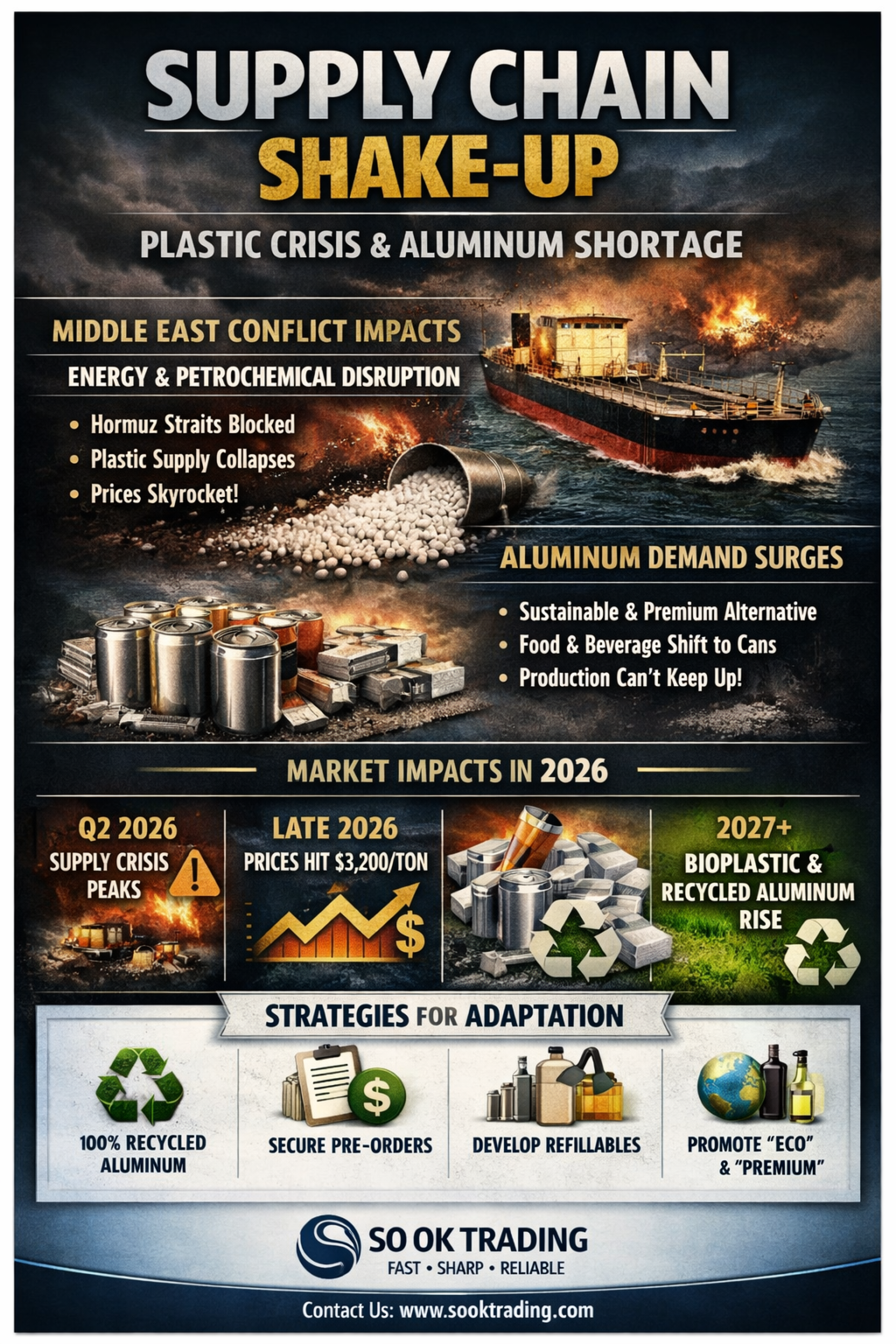
Hormuz Strait Blocked: Oil and petrochemical shipments halted, forcing many factories to suspend plastic resin production.
Rapid Stock Decline: In Thailand and Southeast Asia, plastic resin stockpiles are only sufficient until April–May 2026.
“Money Can’t Buy It”: Even with buyers willing to pay, supply cannot reach the market, creating a severe packaging plastic shortage.
 

Aluminum Packaging as the Alternative

100% Recyclable: Fully reusable, meeting ESG and Net Zero requirements.
Premium Image: Aluminum cans and packaging are perceived as more eco-friendly and upscale than plastic bottles.
Demand Surge: Food, beverage, and cosmetics industries are rapidly shifting to aluminum.
 

Aluminum Packaging Shortage Emerges

Transport Disruptions: Aluminum shipments from the Middle East face the same bottlenecks as plastics.
Production Capacity Shortfall: Middle Eastern smelters partially offline, reducing supply.
High Energy Costs: Aluminum smelting consumes vast electricity; European and Asian plants cut output.
Price Spike: Aluminum prices hit $3,200 per ton, the highest in years, burdening packaging producers.
 

Market Outlook 2026

Q2 2026: Peak supply crunch—both plastic and aluminum in shortage simultaneously.
Late 2026: Some stabilization, but prices remain higher than the previous year.
2027+: Market enters a “new balance” with recycled aluminum and bioplastics taking permanent market share.
 

Opportunities for Producers and Users

Shift to Green Packaging: Use recycled aluminum to differentiate and mitigate cost risks.
Secure Forward Contracts: Lock in prices and supply to hedge against volatility.
Develop Refillable Packaging: Enhance sustainability and reduce reliance on virgin materials.
Positive Consumer Communication: Turn crisis into opportunity by promoting “Eco-Friendly” and “Premium” packaging with NEO (Natural Plastic) or 100% recycled aluminum.
 

✨ Conclusion

This war has not eliminated plastic, but transport and energy costs have become major obstacles, pushing industries toward aluminum. Yet as demand outpaces supply, aluminum itself faces shortages.

This is a golden opportunity to pivot toward recycled packaging and innovation. In a world where supply chain disruption is the new normal, sustainable and circular materials will be the key to survival for the packaging industry.

 
SO OK TRADING: Your Trusted Business Partner
FAST • SHARP • RELIABLE
www.sooktrading.com


Related Content
“CBAM & Carbon Credit: Transforming Global Trade — From Cost to Opportunity, Adapting Early with Carbon Footprint as the Survival Blueprint for Thai Businesses in the Green Era”
CBAM & Carbon Credit: A Guide for Thai Businesses to the New Global Trade Alongside “Carbon Footprint: The Blueprint for Future Business” The EU’s CBAM regulation is reshaping global trade entirely! Thai businesses—especially exporters and SMEs—must act quickly: measuring carbon emissions, adopting clean energy, and offsetting with carbon credits.
21 Feb 2026
“ADC12: Forging the Future to 2040 — The Backbone of EVs and the Circular Economy, Where Cost-Efficiency Meets Sustainability"
The application trends of ADC12 are undergoing a significant transformation. Once regarded primarily as a low-cost casting material, ADC12 is now evolving into a strategic resource driven by sustainability and advanced technologies — especially in the fields of electric vehicles (EVs), renewable energy, and smart electronic structures. This infographic provides a comprehensive overview of ADC12, highlighting its key properties, major industrial applications worldwide, market pricing, and future development trends. From vacuum casting to AI-powered zero-defect manufacturing, it illustrates the next generation of innovation at a glance. If you are a manufacturer or procurement professional seeking high-quality aluminum casting materials that balance cost-efficiency with sustainability, SO OK TRADING is the trusted partner you can rely on. With expertise spanning metals, non-metals, agricultural products, and green energy, we deliver transparent and reliable services tailored to global markets.
25 Feb 2026
HNY 2026 with a First Analysis on Thai Baht Value
he Thai baht in Q1 2026 is expected to strengthen against the US dollar, driven primarily by a weaker dollar globally, a seasonal tourism boost, and expectations of US Federal Reserve rate cuts. This strength is occurring despite a weak domestic economic outlook and the Bank of Thailand's (BoT) likely continued easing of its policy rate. Exchange Rate Drivers and Forecast External Factors: The primary driver for the strengthening baht is external, mainly the broad weakness of the US dollar as global markets price in expected Fed rate cuts. The baht is also correlated with global gold prices, which have been climbing. Tourism High Season: The period extending into Q1 2026 is the high season for tourism, which typically brings in foreign currency and supports the baht's value. Policy Divergence: The BoT is expected to continue its easing cycle, potentially cutting the policy rate further to 1.00% by Q1 2026 to stimulate the sluggish domestic economy. This divergence from a potentially less aggressive US Fed in Q1 could support the baht in the short term, though some analysts warn the currency could weaken later in 2026. Forecasts: Projections for 2026 generally place the baht in a range of 30.80–33.00 per US dollar. Some models estimate it could trade around 31.06 by the end of Q1. A persistently strong baht below 31 per US$ is seen as a significant risk to the Thai export and tourism sectors. Key Economic Context Weak Growth: Thailand's economy is expected to slow down to a 5-year low growth rate of around 1.6-1.8% in 2026, pressured by US tariffs, global trade tensions, and high household debt. The central bank chief expects an improvement in Q1 2026 after a weak second half of 2025. Political Uncertainty: A general election expected in February 2026 could also introduce volatility, though some historical trends suggest the baht may strengthen following the formation of a new government. Low Inflation: Headline inflation is projected to remain subdued or even negative, providing the central bank with justification for further rate cuts to stimulate demand. In summary, Q1 2026 is characterized by a strong and volatile baht driven by external factors, contrasting sharply with a weak domestic economy and accommodative monetary policy.
1 Jan 2026
This website uses cookies for best user experience, to find out more you can go to our Privacy Policy and Cookies Policy
Compare product
0/4
Remove all
Compare
Powered By MakeWebEasy Logo MakeWebEasy