Share

Battery to Bullion: Thailand’s Circular Power Play: Lead the Future: Car Batteries & Circular Economy: From Cars to Commodities: The Rise of Lead Recycling
Last updated: 17 Feb 2026
263 Views

Car Batteries & Lead Recycling Industry: Golden Opportunity in the Transition Era

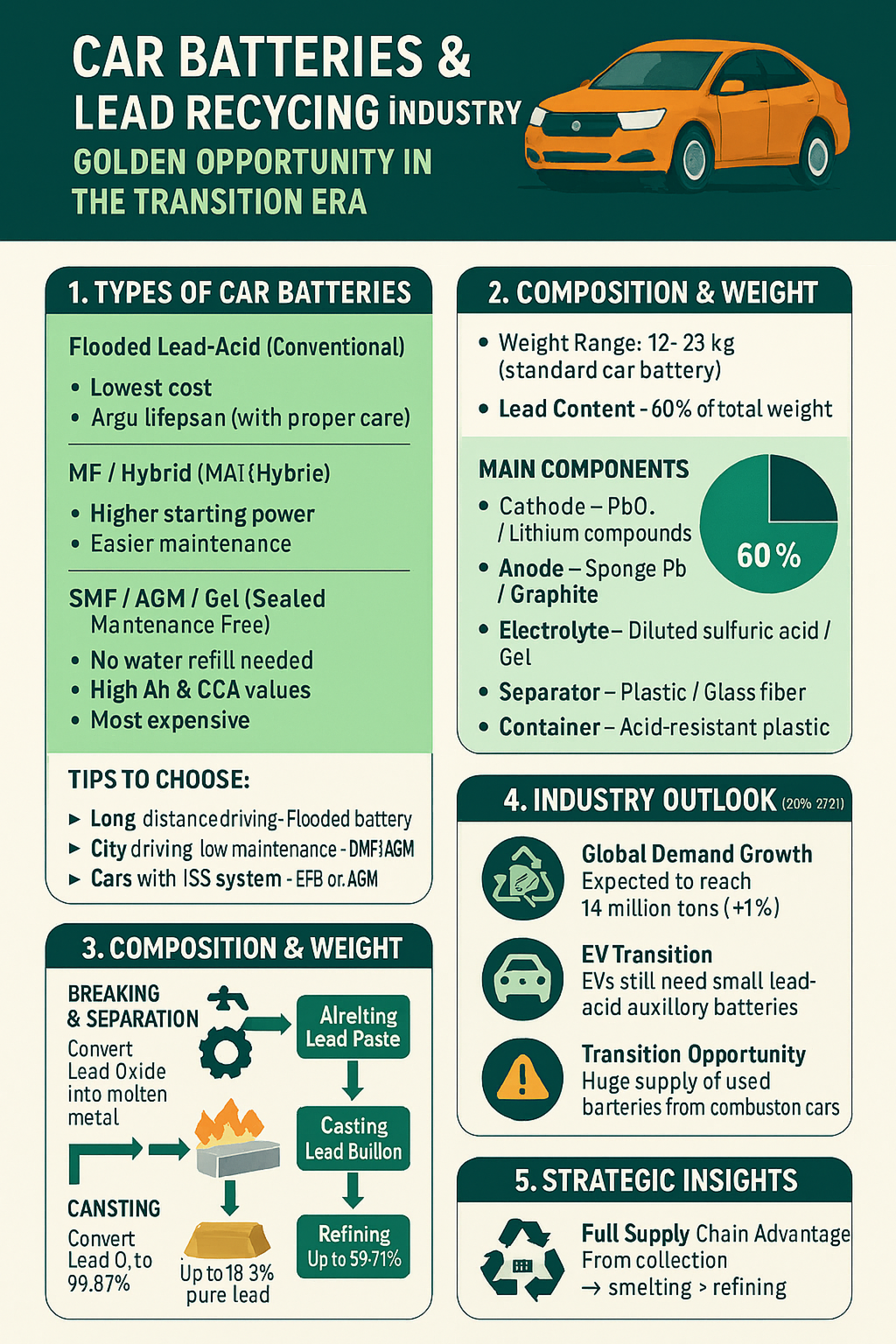
1. Understanding Car Batteries

Car batteries are the heart of a vehicle’s electrical system. Whether in combustion-engine cars or electric vehicles, every car requires a battery to start the engine and power essential systems.

Main Types of Car Batteries

Flooded Lead-Acid (Conventional)
Lowest cost
Long lifespan if properly maintained
⚠ Requires regular distilled water refills
MF / Hybrid (Maintenance Free)
⚡ Higher starting power
Easier maintenance
Higher price, occasional water checks still needed
SMF / AGM / Gel (Sealed Maintenance Free)
✅ No water refills required
High Ah and CCA values
Flexible installation
Most expensive
Tips for Choosing:

Long-distance driving → Flooded battery for durability
City driving, low maintenance → SMF/AGM for convenience
Cars with ISS system → EFB or AGM
 

2. Composition & Weight

Standard car batteries weigh 12–23 kg, with lead making up about 60% of the total weight.

Key Components

Cathode: PbO₂ or lithium compounds
Anode: Sponge lead or graphite
Electrolyte: Diluted sulfuric acid or gel
Separator: Plastic or glass fiber
Container: Acid-resistant plastic
Examples by Capacity (Ah):

45 Ah → 12–13 kg
75 Ah → 17–19 kg
100 Ah → 22–25 kg
200 Ah → 55–60 kg
 

3. Recycling Batteries: From Scrap to Lead Bullion

Thailand already has a comprehensive recycling system for lead-acid batteries.

Process Steps

Breaking & Separation: Plastic, acid, and lead paste are separated
Smelting: Lead oxide is converted into molten metal
Casting: Lead Bullion produced (95–98% purity)
Refining: Purity raised to 99.97%
Key Fact: Over 80% of new lead worldwide comes from recycled batteries.


4. Industry Outlook (2026–2027)

Demand Growth: Global demand expected to reach 14 million tons (+1%)
EV Transition: EVs still require small lead-acid auxiliary batteries
Transition Opportunity: Large supply of scrap batteries from combustion cars
⚠ Challenges:
Competition for scrap batteries
Rising energy costs and stricter environmental standards
Lead price volatility linked to LME
 

5. Strategic Summary

Full Supply Chain Advantage: Companies managing collection → smelting → refining gain cost and profit edge
Eco-Friendly Technology: Key to long-term sustainability
Circular Economy: Recycling is the golden opportunity
 

✨ Conclusion
Car batteries are more than just a starting device. They represent a business that connects circular economy principles with the global metals industry. In 2026, Thai entrepreneurs have a unique chance to become key players if they embrace sustainable technology and complete supply chain management.

If you are interested in high-quality Lead Bullion or Lead Ingot, produced through advanced recycling processes in Thailand, please contact SO OK TRADING.

Visit our website: www.sooktrading.com and submit your request via the “Give Inquiry” field on the homepage.
Or, you can send us an email directly at sooktrading@outlook.com.


Related Content
Supercycle 2026: The Day the World Buys Precious Metals: From Dollar Weakness to USA–IRAN Conflict: A Turning Point for the Global Commodity Market Analysis by SO OK TRADING
On January 29, 2026, the global metals and commodities market witnessed a historic moment. Gold, silver, copper, and aluminium all surged to new All-Time Highs, marking the onset of a powerful Supercycle. The rally was driven by multiple forces: the U.S. dollar falling to its lowest level in four years, escalating geopolitical tensions between the United States and Iran, China’s restrictive export policies, and booming demand from the EV and AI industries. SO OK TRADING identifies this extraordinary surge as a critical turning point for the global commodity market, offering insights into price movements and strategies for February 2026. While the bullish trend remains intact, overheating signals and correction risks are rising, requiring investors to stay vigilant and manage risk carefully. Despite at the night Gold went down from 5,600 USD/ONZ to 5,000 USD/ONZ LEVEL and Silver at went down from 122USD/ONZ to 115 USD/ONZ Level
30 Jan 2026
ทิศทางการใช้ อลูมิเนียมในอนาคต (ปี2026) , ทิศทางราคาอลูมิเนียม และ สถานะการณ์ Carbon Footprint
ทิศทางในอนาคตของอลูมิเนียมไทยมุ่งเน้น ความยั่งยืน (Sustainability) และ เทคโนโลยีขั้นสูง (Advanced Technology) โดยจะเน้น อลูมิเนียมคาร์บอนต่ำ และ อลูมิเนียมรีไซเคิล เพื่อตอบโจทย์อุตสาหกรรมยานยนต์ไฟฟ้า (EV) และการก่อสร้างที่เป็นมิตรต่อสิ่งแวดล้อม พร้อมพัฒนา การเคลือบผิวใหม่ๆ และระบบเศรษฐกิจหมุนเวียน (Circular Economy) เช่น โครงการ Aluminium Loop เพื่อลดต้นทุน เพิ่มมูลค่า และรักษาความสามารถในการแข่งขันในตลาดโลก. แนวโน้มสำคัญ: การเติบโตในอุตสาหกรรมยานยนต์ไฟฟ้า (EV): รถ EV ต้องการใช้อลูมิเนียมเพิ่มขึ้นมากเพื่อลดน้ำหนัก ช่วยประหยัดพลังงานและเพิ่มระยะทางวิ่ง. ความต้องการอลูมิเนียมคาร์บอนต่ำ (Low-Carbon Aluminium): ตอบสนองมาตรการสิ่งแวดล้อมทั่วโลก (เช่น EU CBAM) โดยเฉพาะการใช้อลูมิเนียมรีไซเคิลสูง ซึ่งลดการปล่อยคาร์บอนได้มาก. เศรษฐกิจหมุนเวียน (Circular Economy): โครงการอย่าง "Aluminium Loop" ขับเคลื่อนการรีไซเคิลบรรจุภัณฑ์อลูมิเนียมครบวงจร เพื่อลดขยะและสร้างมูลค่า. นวัตกรรมการเคลือบผิว (Coating Innovations): การเคลือบผิวแบบใหม่ๆ เพื่อเพิ่มฟังก์ชัน เช่น ป้องกันแบคทีเรีย (Anti-microbial) ทำความสะอาดง่าย (Easy-to-clean) สร้างผิวสัมผัสใหม่. การก่อสร้างแบบสำเร็จรูปและโมดูลาร์ (Modular Construction): ใช้อลูมิเนียมมากขึ้นในการผลิตชิ้นส่วนสำเร็จรูปนอกสถานที่ เพื่อความแม่นยำและลดของเสีย. การบูรณาการพลังงานหมุนเวียน (Renewable Energy): ใช้อลูมิเนียมในโครงสร้างรองรับแผงโซลาร์เซลล์ และระบบพลังงานสะอาดอื่นๆ. ความท้าทาย: ต้นทุนพลังงาน & ห่วงโซ่อุปทาน: ความผันผวนของราคาพลังงานและความท้าทายในห่วงโซ่อุปทาน. การแข่งขัน: ประเทศคู่แข่งเร่งพัฒนาเทคโนโลยีรีไซเคิล ทำให้ไทยต้องพัฒนาต่อเนื่องเพื่อรักษาผู้นำ. โอกาส: ไทยมีศักยภาพด้านแรงงานฝีมือ และอุตสาหกรรมต้นน้ำ-กลางน้ำ-ปลายน้ำที่ครบวงจร. การปรับตัวสู่การผลิตคาร์บอนต่ำสร้างโอกาสทางธุรกิจใหม่ๆ โดยเฉพาะการเป็นผู้นำด้านอลูมิเนียมรีไซเคิล. สรุป: อลูมิเนียมไทยจะก้าวสู่ยุคใหม่ที่เน้น "เขียว" (Green) และ "ฉลาด" (Smart) โดยการรีไซเคิลและเทคโนโลยีจะเป็นหัวใจสำคัญในการสร้างการเติบโตและความยั่งยืน.
16 Dec 2025
"Silicon 2026 – Key Player, Key Price: Discover Metallic Silicon and Global Market Mechanisms by SO OK Trading
Metallic Silicon: A Key Raw Material Driving Global Industry Metallic silicon is an essential raw material powering global industries—from aluminum alloys and chemical products to electronics and solar cells. Its primary sources are quartz and quartzite, which, through smelting in electric arc furnaces, yield silicon with a purity level of 98–99%.
14 Jan 2026
This website uses cookies for best user experience, to find out more you can go to our Privacy Policy and Cookies Policy
Compare product
0/4
Remove all
Compare
Powered By MakeWebEasy Logo MakeWebEasy