Share

SO OK TRADING’S INSIGHT: Vietnam 2026 – The Rising Economic Tiger of Asia, Powered by Non-Ferrous Metals & Semiconductors, on the Path to a Global Economic Future
Last updated: 3 Nov 2026
80 Views

SO OK TRADING’S INSIGHT: Vietnam’s Economy and Industry 2026 – Future Directions

 
Economic Growth (GDP)
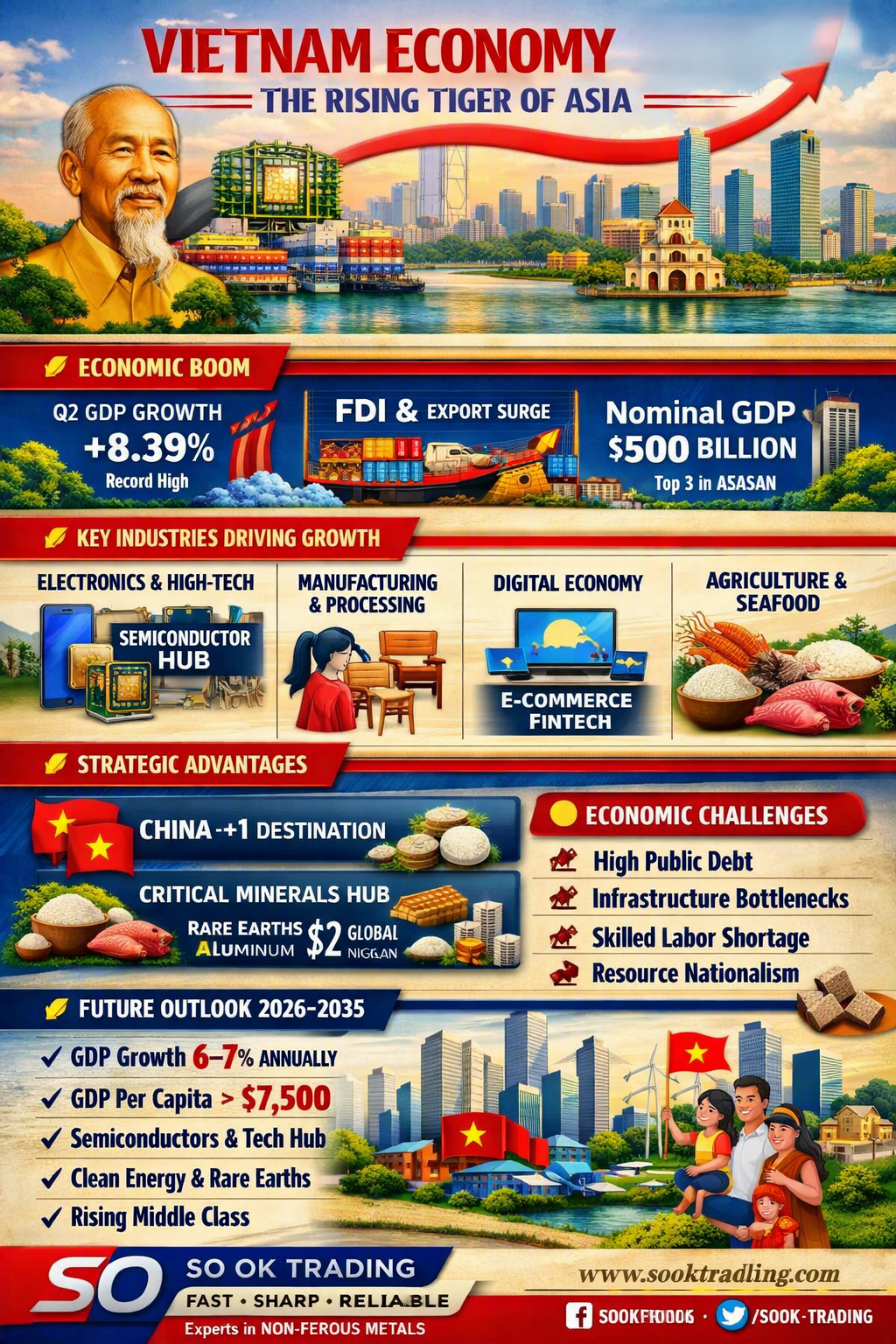
Impressive Numbers: In the first half of 2026, Vietnam’s GDP expanded by 8.18%, with Q2 growth reaching 8.39%, the highest since 2011.
Key Drivers: Foreign Direct Investment (FDI), export-oriented manufacturing, service sector expansion, and government investment.
Nominal GDP: Approaching USD 500 billion, positioning Vietnam to surpass Thailand and become the third-largest economy in ASEAN, after Indonesia and Thailand.
 
National Reform Strategy
Doi Moi 2.0 (Reform 2.0): Streamlining bureaucracy, reducing redundancies, and aiming for developed-country status by 2045.
China Plus One: Benefiting from global production shifts away from China, boosting industrial orders.
 
Key Industries Driving Growth
Electronics & High-Tech

Global hub for smartphones and electronics (Samsung, Apple via Foxconn and Pegatron).
Ambition to become a Semiconductor Hub by 2050, attracting major investments from the US, Taiwan, and Japan.
Manufacturing & Processing

Major exports: footwear, garments, furniture.
Competitive edge through FTAs such as EVFTA and CPTPP.
Services & Digital Economy

Accounts for ~30% of GDP.
Rapid growth in E-Commerce and Fintech, making Vietnam a leader in ASEAN.
Agriculture & Fisheries

GDP share reduced to 17%, but still supports 40% of the workforce.
Leading global exporter of rice, coffee, pepper, and seafood.
 
Challenges & Pain Points
Public Debt: Over USD 162 billion, with rising capital costs.
Infrastructure & Energy: Bottlenecks in logistics and power supply, with industrial zones facing occasional blackouts.
Skilled Labor Shortage: Particularly in advanced technology and semiconductor engineering.
Resource Nationalism: Ban on raw mineral exports, requiring domestic refining and processing.
 
Strategic Strengths: China+1 × Non-Ferrous Metals
Vietnam is not only a “world factory” but also a source of critical upstream resources:

Bauxite (Aluminium): World’s second-largest reserves.
Rare Earths: Second globally, after China.
Tungsten: Nui Phao mine is one of the largest open-pit tungsten mines worldwide.
Nickel & Copper: Supporting EV battery industries.
This combination makes Vietnam a strategic destination for global powers seeking supply chain resilience.

 
Future Outlook (2026–2035)
GDP Growth: Expected to maintain 6–7% annually.
GDP Per Capita: Projected to exceed USD 7,500 by 2035.
Three Pillars of Growth:

Semiconductor & High-Tech Hub
Rare Earths & Clean Energy
Expanding Middle Class & Domestic Consumer Market
 
Conclusion
Vietnam in 2026 is transitioning from a “world factory” to a strategic hub for technology and critical resources. With a strong domestic market of 100 million people, if challenges in debt, infrastructure, and skilled labor are addressed, Vietnam will truly emerge as Asia’s new economic tiger and potentially become a global center for economy and technology in the coming decades.

 
⚙️ SO OK TRADING — FAST • SHARP • RELIABLE The true expert in Non-Ferrous Metals from Thailand www.sooktrading.com Facebook: SOOK TRADING

Related Content
“Copper & Aluminum Supercycle 2026–2027: The Heart of the New Economy in the Age of AI & Clean Energy”   Price Outlook & Supply–Demand Situation | Global Market Outlook | BY SO OK TRADING | 5 SEP 2026
“Copper & Aluminum Supercycle 2026–2027: The Heart of the New Economy in the Age of AI & Clean Energy” Price Outlook & Supply–Demand Situation | Global Market Outlook | BY SO OK TRADING | 5 SEP 2026
5 Sept 2026
SO OK TRADING Metal Market Outlook for Battery Industry & Energy Storage Systems 2026–2030: Antimony Rising Strong, Lead Steady, Lead–Antimony Alloy Demand Remains High
Metal Market Outlook 2026–2030: Lead Steady, Antimony Rising, Lead–Antimony Alloy Demand Remains Strong The year 2026 marks a pivotal turning point for the global metal market. Both base metals and strategic metals clearly reflect the new decade’s economic and energy landscape. Lead (Pb) remains a stable metal, playing a crucial role in backup energy systems and the digital industry. Meanwhile, Antimony (Sb) has become a strategic mineral under global scrutiny, driven by China’s supply control and geopolitical factors. Additionally, Lead–Antimony Alloy (Antimonial Lead Alloy) continues to be indispensable in specialized industries, ranging from industrial batteries to ammunition and chemical applications. Between 2026 and 2030, these metals will embody three defining themes: Stability – Power – Necessity. Lead represents stability, Antimony symbolizes power, and Lead–Antimony Alloy signifies necessity — together driving forward the world’s energy and security industries. SO OK TRADING — Your trusted partner in the Non-Ferrous Metals market from Thailand FAST • SHARP • RELIABLE
10 Sept 2026
HNY 2026 with a First Analysis on Thai Baht Value
he Thai baht in Q1 2026 is expected to strengthen against the US dollar, driven primarily by a weaker dollar globally, a seasonal tourism boost, and expectations of US Federal Reserve rate cuts. This strength is occurring despite a weak domestic economic outlook and the Bank of Thailand's (BoT) likely continued easing of its policy rate. Exchange Rate Drivers and Forecast External Factors: The primary driver for the strengthening baht is external, mainly the broad weakness of the US dollar as global markets price in expected Fed rate cuts. The baht is also correlated with global gold prices, which have been climbing. Tourism High Season: The period extending into Q1 2026 is the high season for tourism, which typically brings in foreign currency and supports the baht's value. Policy Divergence: The BoT is expected to continue its easing cycle, potentially cutting the policy rate further to 1.00% by Q1 2026 to stimulate the sluggish domestic economy. This divergence from a potentially less aggressive US Fed in Q1 could support the baht in the short term, though some analysts warn the currency could weaken later in 2026. Forecasts: Projections for 2026 generally place the baht in a range of 30.80–33.00 per US dollar. Some models estimate it could trade around 31.06 by the end of Q1. A persistently strong baht below 31 per US$ is seen as a significant risk to the Thai export and tourism sectors. Key Economic Context Weak Growth: Thailand's economy is expected to slow down to a 5-year low growth rate of around 1.6-1.8% in 2026, pressured by US tariffs, global trade tensions, and high household debt. The central bank chief expects an improvement in Q1 2026 after a weak second half of 2025. Political Uncertainty: A general election expected in February 2026 could also introduce volatility, though some historical trends suggest the baht may strengthen following the formation of a new government. Low Inflation: Headline inflation is projected to remain subdued or even negative, providing the central bank with justification for further rate cuts to stimulate demand. In summary, Q1 2026 is characterized by a strong and volatile baht driven by external factors, contrasting sharply with a weak domestic economy and accommodative monetary policy.
1 Jan 2026
This website uses cookies for best user experience, to find out more you can go to our Privacy Policy and Cookies Policy
Powered By MakeWebEasy Logo MakeWebEasy