Share

China 2026: Rebalancing the World, Reshaping the Economic Game — Thailand Must Be Ready (Article by SO OK TRADING)
Last updated: 14 Feb 2026
2387 Views

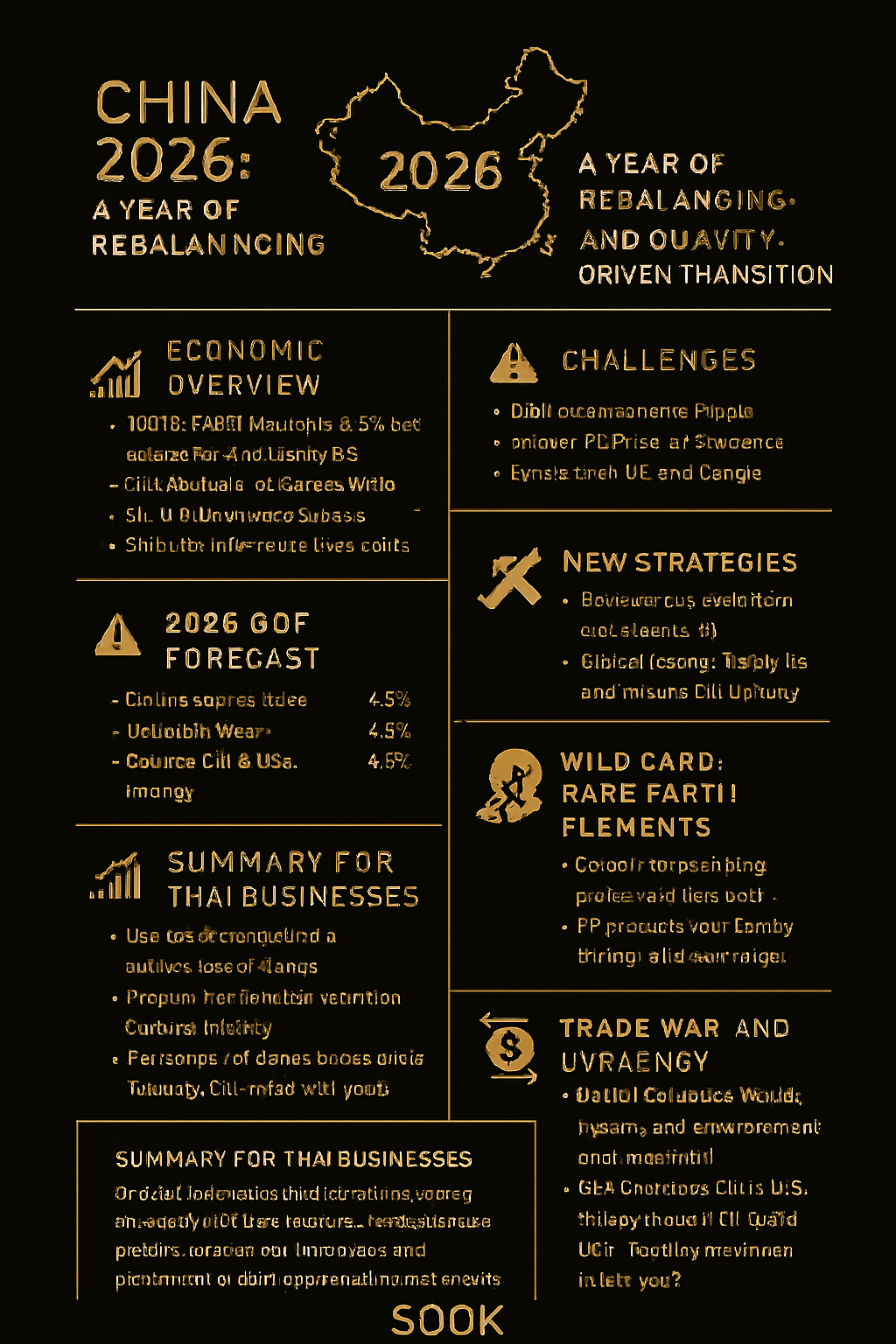
China 2026: A Year of Rebalancing and Quality-driven Transition

In 2026, China’s economy is moving into a new era of quality-driven growth. After achieving its 5% growth target in 2025, the country continues to face pressure from weak domestic consumption and foreign tariff measures.

Economic Overview

GDP 2025: Grew 5.0% overall, but slowed to 4.5% in Q4
Deflation: Producer Price Index (PPI) has declined for 40 consecutive months, reflecting sluggish domestic demand
Exports: The main growth engine, with a trade surplus reaching USD 1.19 trillion despite trade tensions with the U.S.
Stimulus Measures: The People’s Bank of China (PBoC) cut interest rates and subsidized loans to boost consumption
 

⚠️ Ongoing Challenges

Fragile real estate sector affecting household wealth
Intense EV price wars squeezing corporate profits
Tariff pressures from the U.S. and Europe
 

GDP Forecast for 2026

Chinese Government: May set a target below 5% for the first time in years
IMF: 4.5%
Goldman Sachs: 4.8% (optimistic outlook due to strong exports)
Reuters Poll & UBS: Average forecast of 4.5%
 

️ China’s New Strategies

Investment in semiconductors, clean energy, and AI
Focus on exporting high-margin products
Stimulating consumption in tourism and entertainment services
 

Impact on Thailand (Three Key Areas)

Tourism: Chinese tourists shifting from large group tours to FIT (Free Independent Travelers) → Opportunities for wellness hotels and restaurants leveraging digital marketing on Chinese platforms
Products & Manufacturing: Influx of cheap Chinese goods into Thailand → Pressure on Thai SMEs, but consumers benefit from lower prices
Investment: Export-related Thai stocks may fluctuate; Chinese equity funds should focus on high-tech and green energy sectors


Related Content
ALUMINUM PRICE TREND 2026
An analysis of the aluminum market in 2026 indicates a likely continued market deficit and upward price pressure, driven by constrained supply and resilient demand from green energy sectors. However, significant volatility is expected due to policy uncertainties and the potential for new Indonesian supply to eventually balance the market. Key Drivers and Projections for 2026 Supply Side Analysis Capacity Constraints: China's primary aluminum output is approaching its self-imposed 45 million-tonne capacity cap, limiting global supply growth. Power Challenges: Smelters outside of China face intense competition for power from energy-intensive sectors like AI data centers, which are willing to pay higher prices for long-term contracts. This has kept significant capacity offline in Europe and the US. Production Disruptions: Outages and potential shutdowns at existing smelters in Iceland and Mozambique further tighten the market. Scrap Supply Pressure: The EU's planned implementation of the Carbon Border Adjustment Mechanism (CBAM) and potential scrap export tariffs in spring 2026 are expected to impact global scrap flows, creating regional shortages and price volatility. New Capacity: Indonesia is a key source of new supply, with several projects in the pipeline. However, analysts suggest the pace of the ramp-up may be slower than expected due to infrastructure and policy challenges, meaning it is unlikely to fully offset near-term tightness. Demand Side Analysis Green Transition Demand: Demand from "green" sectors such as solar panels, new energy vehicles, and energy transition infrastructure remains strong, providing fundamental support for the market. Substitution Effect: Aluminum's wide price discount relative to copper has encouraged substitution in electrical applications, acting as a tailwind for demand and prices. Construction and Automotive: The construction and automotive industries continue to be major consumers, with growing demand for lightweight, low-carbon aluminum products. Price Forecasts and Volatility The market is expected to remain in a deficit in 2026, with estimates ranging from 200,000 to 600,000 tonnes. This structural tightness is leading most analysts to forecast sustained or rising prices. Bullish Views: Analysts at Bank of America project prices of $3,000/tonne as early as 2026. J.P. Morgan also expects prices to approach $3,000/tonne in Q1 2026. ING forecasts an average price of $2,900/tonne for the year. Bearish/Conservative Views: Goldman Sachs is an outlier, forecasting prices to decline to $2,350/tonne by Q4 2026, anticipating a market surplus later in the year. SMM forecasts a "high first, then lower" pattern, with prices finding equilibrium in the $2,700–$2,800/tonne range by year-end. Premiums: Regional premiums, particularly the US Midwest premium, are expected to remain high and volatile due to tariffs and regional supply dynamics, creating a disconnect from the LME benchmark price. In essence, 2026 is projected to be a year of high volatility where participants need to focus on scenario readiness rather than relying on a single price forecast, as geopolitical and energy policies significantly influence regional supply and costs
31 Dec 2025
SO OK INSIGHT: Global Oil Prices Plunge – When Geopolitics Reshapes the Industrial World   (27 May 2026)
SO OK INSIGHT: Global Oil Prices Plunge – Geopolitical Easing Reshapes the Energy World (27 May 2026) Article Global crude oil prices have dropped to their lowest level in five weeks. Brent crude fell below $100 per barrel, while WTI settled at $92.78 per barrel. The decline follows progress in peace talks between the United States and Iran, raising hopes for reopening the Strait of Hormuz and easing supply concerns. This adjustment reflects more than just market volatility — it highlights a geopolitical shift that directly impacts global commodities, from naphtha and petrochemicals to fertilizers and alternative energy sources. For Thailand, this situation could become a golden opportunity. Lower oil prices reduce energy costs and pave the way for economic recovery in the second half of 2026. SO OK TRADING FAST • SHARP • RELIABLE
27 May 2026
“US–Iran Peace Deal: A Global Turning Point, Ending the War Game — Oil Drops, Stocks Surge, Gold Shakes!”   SO OK TRADING|15 June 2026
US–Iran Peace Deal: Turning Point of the World, Shaking Global Markets SO OK TRADING|15 June 2026 The world is shifting from war to peace. The United States and Iran have announced a permanent ceasefire agreement, with the official signing ceremony scheduled in Geneva on June 19, 2026. This marks a historic geopolitical turning point, reverberating across global energy and financial markets. Oil prices plunged, gold fluctuated, and stock markets surged. This “Deal of the Century” may redefine the trajectory of the global economy for the second half of 2026. SO OK TRADING provides in‑depth analysis: From the key terms of the agreement, Iran’s response, and Israel’s discontent, to the impact on oil, gold, industrial metals, and global currencies.
15 Jun 2026
This website uses cookies for best user experience, to find out more you can go to our Privacy Policy and Cookies Policy
Powered By MakeWebEasy Logo MakeWebEasy